Introduction
The Roland GO:KEYS 5 represents a bold reimagining of the portable arranger keyboard. Departing from the traditional \”auto-accompaniment\” paradigm, the GO:KEYS 5 centers on ZEN-Core synthesis, a chord sequencer, and loop-based creativity—targeting modern creators, beginners, and mobile producers who want instant musical results without deep menu diving. At 3.9 kg with battery operation, it’s designed to be grabbed, powered on, and played anywhere.
This review evaluates whether the GO:KEYS 5 succeeds as a creative sketchpad and whether its arranger DNA translates meaningfully to a loop/sequence workflow.
Design and Build Quality
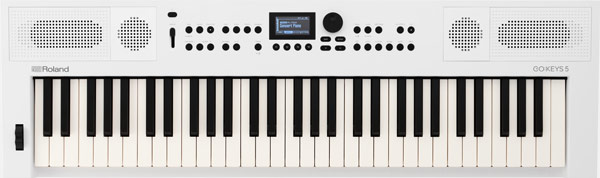
The GO:KEYS 5’s red-and-black color scheme, rounded corners, and integrated handle announce its portable intent. At 930 mm wide, 258 mm deep, 96 mm high, and 3.9 kg, it’s the lightest 61-key instrument in Roland’s current lineup—easily carried one-handed in its included soft case.
The build is all plastic but feels solid: no panel gaps, secure keybed, and a recessed control surface that survives bag transport. The touch-sensitive control strip (replacing traditional knobs/sliders) is a distinctive design choice: swipe left/right to scroll parameters, tap to select, hold for fine adjustment. It’s divisive—some love the minimalist aesthetic, others miss tactile feedback.
The 16 RGB pads (4×4 grid) dominate the left panel, serving as chord triggers, loop launchers, and performance controls. They’re velocity-sensitive with polyphonic aftertouch (via pressure), providing expressive control unusual at this price.
Connectivity is modern and minimal: 1/4-inch L/Mono and R outputs, headphone jack, USB Type-C (audio 2-in/2-out, MIDI, power delivery), and Bluetooth MIDI/Audio. No MIDI DIN, no pedal jack (sustain via on-screen button or optional Bluetooth pedal), no USB Type-A. The USB-C port handles charging, computer audio/MIDI, and USB-C headphones/interfaces.
Keybed and Action: 61-Key Box-Shape
The 61-key (C2–C7) box-shape keyboard uses a spring-return mechanism with velocity sensitivity. It’s a basic synth action: light touch, short travel (~9 mm), no weighting, no escapement, no aftertouch (pad aftertouch is separate).
For the GO:KEYS 5’s intended use—chord triggering, melody playing, bass lines, pad chords—the action is adequate. The light touch facilitates fast runs and reduces fatigue during extended mobile sessions. However, pianists will find it wholly unsuitable for expressive piano playing: no dynamic nuance, no graded response, no mechanical feedback.
Three velocity curves (Light, Medium, Heavy) plus Fixed are available. The narrow 5-octave range limits two-handed piano repertoire but suffices for lead/synth/organ playing.
Sound Engine: ZEN-Core (Creative Focus)
The GO:KEYS 5 runs a streamlined ZEN-Core engine with 1,154 tones organized for immediate creative access:
Categories (dedicated buttons): Piano, E.Piano, Organ, Synth Lead, Synth Pad, Bass, Strings, Brass, Wind, Vocal, World, SFX, Drum Kit, Loop Kit, User.
Each tone uses up to 2 partials (vs. 4 on full ZEN-Core), with simplified editing: filter cutoff/resonance, amp/filter envelope attack/release, LFO rate/depth, and a 4-slot modulation matrix. The Tone Remain function sustains held notes when switching tones—a critical feature for live looping.
Loop Kits are a GO:KEYS 5 specialty: multi-sampled drum/percussion kits mapped across the keyboard with per-note effects, choke groups, and velocity layers. 50+ Loop Kits cover electronic, acoustic, world, and hybrid styles.
Expansion via Roland Cloud (Wi-Fi required) adds tones, loop kits, and patterns.
Polyphony and Performance
128-note polyphony is generous for this class and rarely exhausted in typical loop-based workflows. The engine manages voice stealing gracefully, prioritizing chord sequencer notes and pad-held notes.
Chord Sequencer: The Creative Core
The Chord Sequencer is the GO:KEYS 5’s defining feature. It records chord progressions (up to 8 bars, 4/4 or 3/4) in real-time or step mode, then plays them back in a loop while you improvise melodies, trigger loops, or manipulate sounds. Key capabilities:
– Chord detection: plays a chord → sequencer analyzes and stores the harmony
– Auto-transpose: recorded progression transposes to match live playing key
– Style variations: 203 accompaniment styles (Pop, Rock, Jazz, EDM, Hip-Hop, Latin, etc.) with Intro/Ending/Fill
– Chord voicing: Closed, Open, Spread, 4-note, 3-note options
– 304 chord patterns per style for rhythmic variation
– Tempo sync: 40–240 BPM, tap tempo, MIDI clock sync
– Undo/Redo: instant correction during live building
The workflow: select a style → play chords on the keyboard (or tap pads) → sequencer captures progression → loop plays → improvise over it → add layers → capture as a Scene.
Loop Performance and Scenes
16 RGB pads launch loops, trigger one-shots, control the chord sequencer, and manipulate effects. Pad modes:
– Loop Launch: each pad = a loop (drum, bass, chord, FX) synced to master tempo
– Chord Pad: each pad = a chord from the current progression (transposable)
– One-Shot: FX hits, vocal chops, risers
– Scene Control: recall complete setups (tones, loops, sequencer state, effect settings)
64 Scenes (16 banks × 4) store complete creative states for instant recall during performance or production sessions.
Connectivity and Workflow
USB-C is the universal port: 2-in/2-out audio interface (44.1 kHz/24-bit), MIDI, and power delivery (can charge from laptop or power bank). Bluetooth MIDI/Audio connects to mobile DAWs (GarageBand, Cubasis, etc.) and the Roland GO:KEYS app for deep editing, sound management, and firmware updates.
Battery operation (6× AA alkaline ~5 hours, NiMH ~7 hours) enables true cable-free creation. The USB-C power delivery means you can charge while playing from a power bank.
Roland GO:KEYS App (iOS/Android) provides:
– Tone/Loop Kit browser with audition
– Chord Sequencer visual editor
– Scene management
– Effect parameter access
– Firmware update
– Content download (Roland Cloud)
Effects and Processing
Effects are performance-oriented:
– MFX (64 types): Filter, Distortion, Delay, Reverb, Modulation, Lo-Fi, Vinyl, etc. — assignable per part
– Master Reverb/Delay: shared send
– Master Compressor/EQ: final polish
– Pad FX: per-pad effect assignments (filter sweep, delay freeze, pitch drop, etc.)
The Touch Strip controls the assigned MFX parameter in real-time—swipe for filter sweeps, tap for delay time, hold for reverb swell.
Specifications Summary
| Category | Specification |
|———-|—————|
| Keyboard | 61-key box-shape, velocity sensitive, no aftertouch |
| Sound Engine | ZEN-Core (streamlined, 2 partials max) |
| Maximum Polyphony | 128 notes |
| Preset Tones | 1,154 |
| Loop Kits | 50+ |
| Chord Sequencer | 8 bars, 4/4/3/4, auto-transpose, 203 styles, 304 patterns |
| Pads | 16 RGB, velocity sensitive, polyphonic aftertouch (pressure) |
| Scenes | 64 (16 banks × 4) |
| Effects | MFX (64 types, per part), Master Reverb/Delay, Master Comp/EQ, Pad FX |
| Control Strip | Touch-sensitive parameter control |
| Connectivity | USB-C (audio 2-in/2-out, MIDI, power), Bluetooth MIDI/Audio, 1/4-inch L/Mono/R, Headphones |
| Battery | 6× AA (alkaline ~5h, NiMH ~7h), USB-C PD |
| Display | None (app-based), 16 RGB pads + status LEDs |
| Dimensions (W x D x H) | 930 x 258 x 96 mm (36-5/8 x 10-3/16 x 3-3/4 in) |
| Weight | 3.9 kg (8 lbs 10 oz) |
| Power | 5 W (USB-C PD or batteries) |
| Colors | Red/Black |
Value and Verdict
The Roland GO:KEYS 5 is not a traditional arranger keyboard—it’s a mobile creative workstation that repurposes arranger technology (styles, chord recognition, auto-accompaniment) for loop-based composition and performance. For beatmakers, singer-songwriters, streamers, and mobile producers, it offers an uniquely immediate path from idea to arranged sketch.
The compromises are deliberate: no piano-grade action, no deep synthesis editing on hardware, no MIDI DIN, no pedal jack, limited tone count vs. full ZEN-Core. But these omissions enable the 3.9 kg weight, battery operation, and -class pricing.
Pros:
– ZEN-Core sound quality in ultra-portable format
– Chord Sequencer enables instant arrangement building
– 16 RGB pads with polyphonic aftertouch for expressive loop performance
– 128-note polyphony handles dense loops
– USB-C audio/MIDI/power + Bluetooth MIDI/Audio
– Battery operation (AA or USB-C PD)
– 64 Scenes for live set management
– 1,154 tones + 50+ Loop Kits + expansion via Roland Cloud
– Touch Strip for real-time effect manipulation
Cons:
– Box-shape keyboard unsuitable for piano playing
– No hardware deep editing (app required)
– No MIDI DIN, no pedal jack
– Limited to 2 partials per tone (vs. 4 on full ZEN-Core)
– No display (app-dependent visual feedback)
– 1,154 tones may feel limited for sound designers
– Chord Sequencer limited to 8-bar loops
– No onboard audio recording (requires computer/mobile)
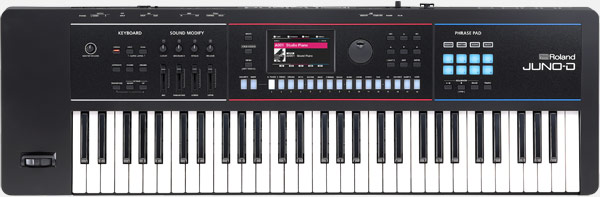
Bottom Line: The Roland GO:KEYS 5 succeeds brilliantly at its redefined mission: it’s a portable creative sketchpad that turns chord progressions into arranged loops in seconds. For the modern mobile creator, it’s an inspiring tool. For the traditional pianist or arranger player, it’s the wrong instrument—look to the FP series or JUNO-D instead.