Introduction
The Roland JUNO-D6 brings the same ZEN-Core synthesis engine and expansive 3,800+ tone library as its 76-key sibling into a lighter, more affordable 61-key package. At 10.2 kg and a street price significantly below the JUNO-D8, the D6 targets keyboardists who prioritize portability and value over extended keyboard range. For synth players, organists, and gigging musicians who rarely venture beyond five octaves, the JUNO-D6 may represent the optimal balance in the current JUNO-D lineup.
This review examines whether the 61-key format compromises the JUNO-D experience or simply distills it to its essence.
Design and Build Quality
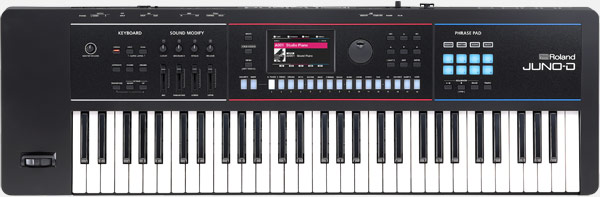
The JUNO-D6 shares the JUNO-D8’s design language: matte-black finish, textured side panels, and the same logical control layout. At 950 mm wide, 329 mm deep, 109 mm high, and 10.2 kg, it’s remarkably compact for a professional workstation—easily fitting on a single-tier stand with room for a laptop or module beside it.
The 3.5-inch color LCD, eight category buttons, eight assignable sliders, pitch bend/mod lever, and transport controls are identical to the D8. Build quality feels equally solid with no chassis flex. The reduced width actually improves ergonomics: all controls fall naturally under the hands without excessive reach.
Connectivity matches the D8: balanced 1/4-inch L/Mono and R outputs, headphone jack, dual pedal inputs (damper + assignable), MIDI In/Out, USB Type-B (audio 2-in/2-out, MIDI), and USB Type-A for memory.
Keybed and Action: 61-Key Semi-Weighted
The 61-key semi-weighted action (C2–C7) uses the same spring-return mechanism as the D8. The reduced range actually benefits synth and organ playing—the action feels slightly snappier with less mass to move, and the 5-octave span covers the vast majority of lead, pad, and comping duties.
For two-handed piano playing, the 61-key range is limiting (missing the bottom octave and top half-octave), but split/layer workflows mitigate this: left-hand bass split below C3, right-hand piano above. The action’s moderate resistance and quick return excel at organ glissandi, synth runs, and rhythmic comping.
Channel aftertouch provides expressive control for compatible sounds. Three velocity curves plus Fixed accommodate different touch preferences.
Sound Engine: ZEN-Core (Identical to JUNO-D8)
The JUNO-D6 runs the identical ZEN-Core engine with the same 3,800+ preset tones, 128-note polyphony, 256 MB expansion memory, and 4-partial tone architecture. Every sound, parameter, and editing capability is shared between the D6 and D8. The only differences are keyboard range, weight, dimensions, and price.
This means JUNO-D6 owners get the same acoustic pianos, electric pianos, organs, synths, strings, brass, pads, basses, drums, and world instruments as the flagship D8. The same MFX/Reverb/Chorus effects, same phrase pads, same pattern sequencer, same USB audio interface.
Polyphony and Performance
128-note polyphony performs identically to the D8. The 61-key range actually reduces the likelihood of polyphony exhaustion—fewer keys means fewer simultaneous notes in typical playing. Dense layering (piano + pad + strings + bass split) remains well within limits.
The Phrase Pad (16 pads × 4 banks), Pattern Sequencer (100 patterns × 16 tracks), and Audio Recorder (WAV 44.1/16) are unchanged.
Connectivity and Workflow
Identical to JUNO-D8: USB 2-in/2-out audio interface, JUNO-D Editor (VST3/AU/standalone), Roland Cloud integration, Function shortcuts, and bidirectional USB MIDI communication.
Effects and Processing
Identical MFX (90 types per part), Reverb (10+10), Chorus (10+10), Master EQ (4-band), Master Compressor, Part EQ (3-band). The same VCM-derived emulations of classic Roland processors.
Live Performance Features
Scenes (100 user), Live Sets (16 × 16), Favorites (64), Arpeggiator (128+16), Chord Memory (8)—all identical. The 61-key range actually makes split/layer workflows more intuitive: the split point falls naturally under the left hand’s natural position.
Specifications Summary
| Category | Specification |
|———-|—————|
| Keyboard | 61-key semi-weighted, velocity sensitive, channel aftertouch |
| Sound Engine | ZEN-Core (PCM + Virtual Analog) |
| Maximum Polyphony | 128 notes |
| Preset Tones | 3,800+ |
| Wave Memory | 256 MB expansion + USB |
| Effects | MFX (90 types, per part), Reverb (10+10), Chorus (10+10), Master EQ (4-band), Master Compressor |
| Sequencer | Pattern (100 x 16 tracks), Phrase Pad (64 phrases), Audio Recorder (WAV 44.1/16) |
| Audio Interface | USB: 2-in/2-out @ 44.1 kHz/24-bit |
| Display | 3.5-inch color LCD (320 x 240) |
| Dimensions (W x D x H) | 950 x 329 x 109 mm (37-3/8 x 12-15/16 x 4-3/8 in) |
| Weight | 10.2 kg (22 lbs 8 oz) |
| Power | 12 W (AC adapter) |
Value and Verdict
The Roland JUNO-D6 is a rare case where the \”lesser\” model may be the better choice for many users. By shedding 15 keys and 2.3 kg, it gains significant portability while retaining 100% of the sound engine, polyphony, effects, sequencing, and connectivity. For synth players, organists, band keyboardists, and producers who work primarily in a 5-octave range, the JUNO-D6 delivers the full JUNO-D experience at a lower price and weight.
The only genuine compromise is the 61-key range for two-handed piano repertoire. If your work regularly requires the bottom A0–B1 or top C7–C8, the D8 (or an 88-key alternative) is necessary. Otherwise, the D6 is the value champion of the series.
Pros:
– Identical ZEN-Core engine and 3,800+ tones as JUNO-D8
– 128-note polyphony unchanged
– 10.2 kg weight is exceptionally portable
– 61-key format ideal for synth/organ/lead playing
– All workflow, effects, sequencing, and connectivity features retained
– Lower price point
– Balanced outputs for professional stage use
Cons:
– 61-key range limits two-handed piano playing
– Semi-weighted action still not a piano-grade hammer action
– Combined pitch bend/mod lever
– 256 MB expansion memory limit
– Small 3.5-inch LCD for deep editing
Bottom Line: The Roland JUNO-D6 proves that sometimes less is more. For the vast majority of gigging keyboardists, its 61-key format, 10.2 kg weight, and identical sound engine make it the most practical and cost-effective choice in the JUNO-D family.
Check current price and availability: View on zZounds