Introduction
The Roland FANTOM 8 EX stands at the summit of Roland’s workstation lineage, representing over three decades of synthesis innovation distilled into a single instrument. Since the original FANTOM debuted in 2001, each generation has pushed the boundary of what a stage and studio workstation can achieve. The FANTOM 8 EX, launched as the flagship of the refreshed FANTOM EX series, combines three distinct sound engines—ACB (Analog Circuit Behavior), V-Piano, and Zen-Core—under a unified architecture that seamlessly bridges performance, production, and sound design.
This review examines whether the FANTOM 8 EX justifies its flagship positioning and premium price point. We evaluate its 88-key PHA-50 keyboard, triple-engine sound architecture, 256-note polyphony, deep DAW integration, and real-world usability for touring professionals and studio composers alike.
Design and Build Quality
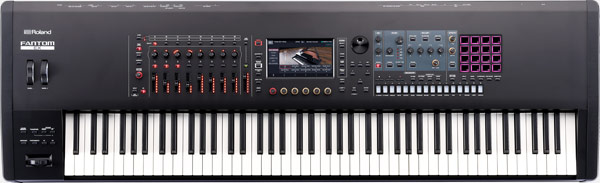
The FANTOM 8 EX commands immediate presence with its brushed aluminum top panel, matte-black side cheeks, and a 7-inch color touchscreen that dominates the control surface. At 1,446 mm wide, 460 mm deep, and 170 mm high, weighing 28.1 kg, it is a substantial instrument that demands dedicated stage space or a sturdy studio stand. The build feels uncompromising: metal chassis, reinforced corners, and a lid that closes flush protect the interior during transport.
Control layout follows Roland’s modern design language: eight assignable faders, eight rotary encoders, a super knob, six display knobs, and a comprehensive transport section. Every control feels precise with a satisfying detent. The touchscreen is responsive, bright, and readable at extreme angles—critical for stage lighting conditions. Dedicated category buttons for Piano, E.Piano, Organ, Synth, Pad, and others provide instant sound access without menu diving.
Connectivity is exhaustive: balanced XLR outputs, 1/4-inch main outs, two assignable 1/4-inch outs, headphone jack, dual pedal inputs (damper and assignable), expression pedal input, MIDI In/Out/Thru, two USB Type-A ports (for memory and Wi-Fi adapter), USB Type-C for computer connectivity, and Ethernet for wired network integration. The inclusion of analog XLR outputs with ground-lift capability is a professional touch that eliminates ground-loop issues in venue installations.
Keybed and Action: PHA-50
The FANTOM 8 EX features Roland’s PHA-50 (Progressive Hammer Action) keyboard with 88 keys, escapement simulation, and ivory-feel texture on the white keys. The action uses a hybrid construction: wooden side pieces with molded plastic keytops, delivering the tactile warmth of wood while maintaining consistency across temperature and humidity variations.
In practice, the PHA-50 strikes an exceptional balance between piano realism and synth playability. The graded weighting feels natural across the compass—heavier in the bass, lighter in the treble—with a distinct escapement click at the bottom of the keystroke that acoustic pianists will recognize. The ivory-feel surface absorbs moisture, preventing slippage during extended sets. Aftertouch is polyphonic, enabling per-note expression for compatible sounds.
For organ and synth playing, the action’s moderate key dip and quick return facilitate fast passages and glissandi. The keybed does not feel “piano-heavy” when playing synth leads or organ runs—a common compromise on hybrid workstations. The three touch sensitivity curves (Light, Medium, Heavy) plus a fixed option accommodate diverse playing styles.
Sound Engine and Voices: Triple-Engine Architecture
The FANTOM 8 EX’s defining feature is its three-engine architecture, each addressing distinct sonic territories:
ACB (Analog Circuit Behavior) recreates Roland’s legendary analog synths—Jupiter-8, Juno-106, SH-101, System-100, Promars, and more—by modeling the actual circuit behavior at the component level. The result is not a sample replay but a living, breathing analog voice that responds to parameter changes with the same non-linearities, drift, and warmth as the original hardware. Filter resonance screams, oscillator sync bites, and PWM evolves with authentic character.
V-Piano provides modeled acoustic and electric pianos without relying on static samples. Each note is calculated in real-time based on physical parameters: string length, hammer mass, soundboard resonance, duplex scale, and cabinet simulation. The result is infinite polyphony for piano sounds (within the engine’s allocation), seamless dynamic response, and the ability to shape parameters that are impossible on sample-based pianos—lid position, string resonance depth, damper noise, and even virtual tuning.
Zen-Core is Roland’s flagship PCM/synthesis engine, delivering over 3,500 tones covering every category: acoustic pianos, electric pianos, organs, strings, brass, pads, leads, basses, drums, and world instruments. Zen-Core supports 4 partials per tone, each with its own oscillator, filter, amplifier, and envelope. The sample library exceeds 50 GB (when converted to 16-bit linear), including stereo multisamples with velocity layers and key-off samples.
The three engines operate simultaneously within a single Scene, which can contain up to 16 parts (8 internal + 8 external/MIDI). Parts can be layered, split, or zoned across the keyboard with crossfade transitions. Each part has independent effects routing, MIDI channel, and controller assignments.
Polyphony and Performance
Polyphony allocation is per-engine: ACB and Zen-Core share a 256-note pool (stereo/mono waveforms), while V-Piano has its own 128-note allocation. In practical terms, this means you can layer a massive Zen-Core pad (64 notes), an ACB analog brass (32 notes), and a V-Piano grand (64 notes) simultaneously without voice stealing. The total 256 + 128 architecture effectively eliminates polyphony anxiety for all but the most extreme layering scenarios.
Scene switching is instantaneous (< 50 ms) with Seamless Sound Switching (SSS), which sustains held notes and effect tails across scene changes. This is a critical feature for live performance where patch changes must not interrupt sustained chords or reverb trails. SSS works across all three engines simultaneously. The Performance Recorder captures MIDI and audio directly to USB storage (up to 24-bit/48 kHz WAV). The Pattern Sequencer offers 128 patterns with 16 tracks each, 480 ppq resolution, and real-time/step recording. The Song Sequencer supports 128 songs with linear arrangement, tempo track, and marker navigation. Connectivity and Workflow Integration The FANTOM 8 EX excels as a studio centerpiece. USB-C provides 4-in/32-out audio interface operation at up to 192 kHz/24-bit, with class-compliant drivers for macOS, Windows, and iOS. The 6-input/32-output configuration at 44.1 kHz (3-input/16-output at 192 kHz) accommodates multitrack recording of the internal engines plus external sources simultaneously. DAW Control mode maps the faders, encoders, and transport to major DAWs (Logic Pro, Ableton Live, Cubase, Pro Tools, Studio One, Reaper, Digital Performer, Cakewalk, Reason). The mapping is bi-directional: DAW parameter changes reflect on the FANTOM's hardware controls, and vice versa. This transforms the workstation into a tactile control surface without sacrificing its sound generation capabilities. FANTOM Editor (VST3/AU/standalone) provides deep visual editing of every parameter on a computer screen, with full patch librarian functions. Patches created in the editor sync instantly to the hardware. Roland Cloud integration allows direct browsing, auditioning, and downloading of expansion content (additional ACB models, Zen-Core waveforms, V-Piano models) over Wi-Fi or Ethernet. The 3 GB internal expansion memory can be supplemented via USB storage. Effects and Processing Each of the 16 parts has dedicated effects: Insertion Effects A/B (363 types including VCM modeling of classic processors), Master Effects (Reverb: 85 preset + 30 user; Chorus: 107 preset + 30 user), Master Compressor (5 preset + 30 user), Master EQ (9 preset + 30 user, 5-band parametric), and Part EQ (28 parts, 3-band). The DSP Variation system provides 363 preset + 30 user algorithms for real-time sound shaping. VCM (Virtual Circuit Modeling) effects deserve special mention: they model the analog behavior of classic Roland processors (SDD-320 Dimension D, RE-201 Space Echo, VP-330 Vocoder chorus/ensemble, etc.) at the circuit level, delivering the same non-linear response and harmonic richness as the hardware originals. Live Performance Features For stage use, the FANTOM 8 EX offers Live Sets (256 user + 256 preset) that organize scenes into setlists with instant recall. Assignable knobs/sliders can be mapped per-scene with custom labels displayed on the OLED sub-display. Keyboard Hold sustains notes after key release for pad/organ layers. Arpeggiator provides 128 patterns with tempo sync, latch, and keyboard split. Chord Memory stores complex voicings for single-finger triggering. The Super Knob enables simultaneous control of up to 128 parameters across all parts with a single gesture—ideal for dramatic filter sweeps, effect morphs, or layered timbral shifts during a performance. Motion Sequencer records knob movements as tempo-synced automation that can be triggered live. Specifications Summary | Category | Specification | |----------|---------------| | Keyboard | 88-key PHA-50 with escapement, ivory feel, polyphonic aftertouch | | Sound Engines | ACB (Analog Circuit Behavior), V-Piano, Zen-Core | | Maximum Polyphony | ACB/Zen-Core: 256 (stereo/mono); V-Piano: 128 | | Preset Tones | 3,500+ (Zen-Core), ACB models (Jupiter-8, Juno-106, SH-101, etc.), V-Piano models | | Wave Memory | 50+ GB (Zen-Core, 16-bit linear equivalent) | | Expansion Memory | 3 GB internal + USB storage | | Effects | Insertion A/B (363 types), Reverb/Chorus (Master), Master Compressor/EQ, Part EQ (28), VCM modeling | | Sequencer | Pattern (128 x 16 tracks), Song (128), 480 ppq | | Audio Interface | USB-C: 4-in/32-out @ 44.1 kHz; 6-in/8-out @ 192 kHz | | DAW Control | Logic, Live, Cubase, Pro Tools, Studio One, Reaper, DP, Cakewalk, Reason | | Display | 7" TFT Color Wide VGA (800 x 480) touch + 128 x 64 sub OLED | | Dimensions (W x D x H) | 1,446 x 460 x 170 mm (56-15/16 x 18-1/8 x 6-11/16 in) | | Weight | 28.1 kg (61 lbs 15 oz) | | Power | 19 W (PA-300C adapter) | Value and Verdict The Roland FANTOM 8 EX is not merely an incremental update—it is a architectural statement that unifies Roland's three most advanced sound technologies into a single, coherent instrument. For the touring keyboardist who needs authentic analog synths, modeled pianos, and a massive PCM library in one road-worthy package, the FANTOM 8 EX eliminates the need for multiple keyboards and a laptop. For the studio composer, its DAW control surface, multichannel audio interface, and VST editor integration make it a production hub that generates sound as capably as it controls the DAW. The compromises are few: the 28.1 kg weight demands a road case and strong back; the price places it in professional territory; the learning curve for the triple-engine architecture is non-trivial. However, these are the cost of admission for an instrument that genuinely does everything at a flagship level. If your work demands the breadth of Zen-Core, the authenticity of ACB, and the expressivity of V-Piano—simultaneously, seamlessly, and reliably—the FANTOM 8 EX has no direct competitor. It is the current benchmark for the all-in-one workstation category. Pros: - Three world-class sound engines operating simultaneously - PHA-50 keyboard sets the hybrid action standard - 256 + 128 polyphony eliminates voice stealing - Seamless Sound Switching for glitch-free live changes - 4-in/32-out USB audio interface with DAW control - VCM effects model classic Roland processors authentically - Instant scene switching with sustained tails - Deep computer integration (Editor, Cloud, DAW Control) Cons: - 28.1 kg weight requires dedicated transport - Premium price point - Steep learning curve for full engine mastery - Only 3 GB internal expansion memory - No built-in speakers (by design for this class) Bottom Line: The Roland FANTOM 8 EX is the definitive flagship workstation of its generation—an instrument that earns its place at the center of professional stages and studios worldwide.
Check current price and availability: View on zZounds