Introduction
The Nord Stage 4 88 arrives as the fourth generation of Clavia’s flagship stage piano, introducing a triple-sensor hammer action keybed, dedicated LED faders per layer, a completely redesigned effect architecture with per-layer processing, and doubled sample memory. At 19.6 kg with an 88-key triple-sensor hammer action, 120-voice piano polyphony, 46-voice synth polyphony, 2 GB piano memory, and 1 GB sample library memory, the Stage 4 88 targets the professional touring keyboardist who demands the widest sonic palette, most expressive control surface, and most reliable stage operation in a single instrument.
This review examines whether the Stage 4’s evolutionary upgrades—triple sensors, layer faders, per-layer effects, doubled memory—justify its premium positioning in the stage piano category.
Design and Build Quality
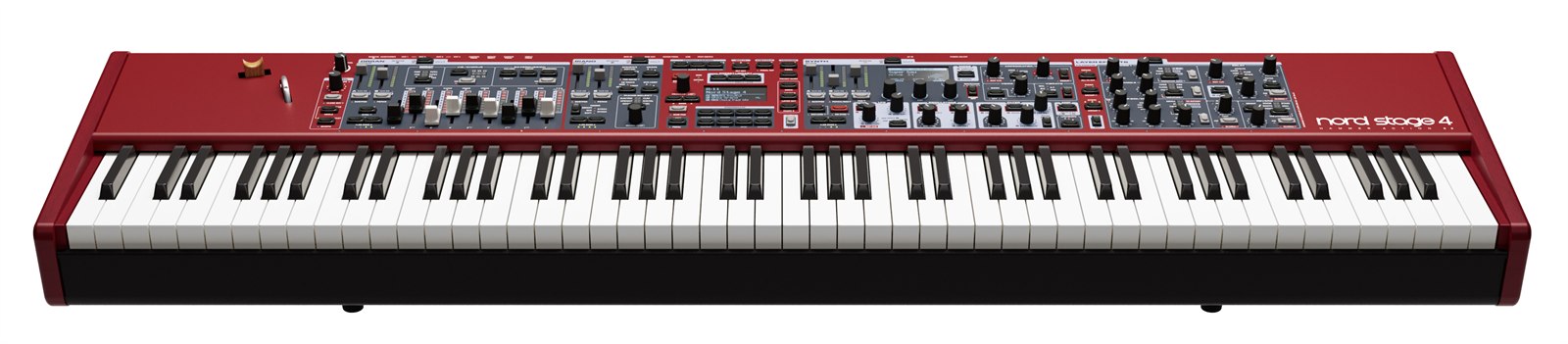
The Stage 4 88 presents a striking, purpose-built aesthetic: matte-red (or black) aluminum top panel, wooden pitch stick, metal knobs/faders, and a dual-OLED display layout (main program display + dedicated synth OLED). At 1,282 mm wide, 349 mm deep, 121 mm high, and 19.6 kg, it commands stage presence while remaining manageable for two-person transport.
The control surface is the most comprehensive in the stage piano class: 16 dedicated LED faders (volume per layer across Piano, Organ, Synth sections), 31 knobs (filter, envelope, effect, modulator controls), wooden pitch stick, modulation wheel, physical drawbars with LED (9 sliders for organ), 8 live program buttons, 2 layer scene buttons, split zone LEDs (up to 3 splits, 4 zones). Every performance parameter has a dedicated physical control—no menu diving during live performance.
The triple-sensor hammer action keybed with aftertouch is the headline hardware upgrade. Three optical sensors per key capture position, velocity, and release velocity with unprecedented precision, enabling true half-pedaling simulation, rapid note repetition, and nuanced dynamic response. The action feels substantial, responsive, and expressive—arguably the best stage piano keybed Clavia has produced.
Connectivity is professional-grade: 4 assignable 1/4-inch outputs (TRS, unbalanced), stereo headphone out, 1/8-inch monitor in, sustain pedal (compatible with Nord Sustain Pedal 2 continuous sensor), triple pedal (5-pin DIN), rotor pedal, swell pedal (TRS), control pedal (TRS), foot switch (2-button), MIDI In/Out (5-pin DIN), USB Type-B (MIDI, updates, sound transfer), IEC power inlet.
Piano Section: 2 GB Memory, 120-Voice Polyphony
The piano section is the Stage 4’s core identity: 2 GB dedicated memory for piano sounds (all replaceable via Nord Sound Manager), 120-voice polyphony, 2 layers (2-part multitimbral). Categories: Grand, Upright, Electric, Digital, Layer, Clav/Harpsichord.
Advanced Piano Features: String Resonance (acoustic grand/upright), Selectable Soft Piano Release, Pedal Noise (with Nord Triple Pedal 1/2 or Sustain Pedal 2), Dynamic Compression, Unison functionality, Piano Timbre controls with custom settings for electric pianos.
The Nord Piano Library (free downloads) provides an ever-expanding collection of sampled grands, uprights, and electric pianos—all swappable into the 2 GB memory via Nord Sound Manager (Mac/Win). This future-proofs the instrument: as new piano samples are released, they can replace existing ones.
Organ Section: 6 Models, Physical LED Drawbars
The organ section features 6 models: B3 Tonewheel, B3 Bass, Vox, Farfisa, Pipe ×2. Physical drawbars with LED provide real-time harmonic control—the LEDs indicate drawbar position even when switching registrations. Rotary Speaker Simulation: Vintage 122 with adjustable drive, live mode, switchable vibrato/chorus. Polyphony shared with piano/synth sections.
Synth Section: Nord Wave 2 Engine, 3 Layers, 46-Voice Polyphony
The synth section runs the Nord Wave 2 engine: Virtual Analog (classic waveforms + shaper, hardsync, noise, super, sync, bell, misc), Samples (1 GB memory, replaceable via Nord Sample Library), FM, Digital Waves. 3 layers (3-part multitimbral), 46-voice polyphony.
Filter: Classic Transistor Ladder (LP M), 12/24 dB LP, HP, BP, LP+BP. Filter Drive: Off, 1, 2, 3. Filter Tracking: Off, 1/3, 2/3, Full. Unison: 3 modes. Vibrato: Controllable from Mod Wheel, Aftertouch, Pedal. Envelopes: Filter, Amplitude, Oscillator (ADR with velocity control). LFO: 5 waveforms (Square, Triangle, Ramp Dn, Ramp Up, Sample & Hold). Arpeggiator: Advanced with Arp, Polyphonic, Gate modes, patterns with Accent/Pan, sync to Master Clock.
Effects Architecture: Per-Layer Independent Processing
The Stage 4 introduces independent effect sections per layer (Piano, Organ, Synth each get their own complete effect chain):
Mod 1: Tremolo, Auto Pan, Ring Mod, Wah-Wah, Auto-Wah, Pump (Sidechain). Mod 2: Phaser, Flanger, Vibe, Chorus, Ensemble, Spin. Delay: Tempo sync, feedback, filter. Reverb: 6 algorithms (Spring, Booth, Room, Stage, Hall, Cathedral) with Dark/Bright modes, Variation/Chorale. Amp Simulation: Multiple models (Twin, etc.) with variation. Rotary: Speed (Stop/Slow/Fast) + Overdrive. Compressor: Fast mode. EQ: 3 bands (100 Hz, 200 Hz–8 kHz, 4 kHz). Effect rates/tempo sync to Master Clock.
This per-layer architecture eliminates the compromise of shared effects: piano reverb doesn’t affect synth delay; organ rotary doesn’t color piano compression.
Performance Features
Layer Scenes: 2 independent setups with seamless morphing (switch between two complete sound configurations instantly). Split Zones: Up to 3 split points (4 zones) with visual LED indicators, crossfade options (Large/Small/Off). Morph Sources: Mod Wheel (also Swell pedal), Control Pedal, Aftertouch. Live Programs: 8 direct-access registrations. Master Clock: Manual, external, tap tempo. MIDI over USB. Transpose: ±6 semitones.
Specifications Summary
| Category | Specification |
|———-|—————|
| Keyboard | 88-key Triple Sensor Hammer Action, aftertouch, range A-C |
| Piano Section | 2 GB memory, 120-voice polyphony, 2 layers, String Resonance, Soft Release |
| Organ Section | 6 models, physical LED drawbars, vintage 122 rotary, vibrato/chorus |
| Synth Section | Nord Wave 2 (VA, Samples, FM, Digital Waves), 1 GB sample memory, 46-voice polyphony, 3 layers |
| Effects (per layer) | Mod 1 (6), Mod 2 (6), Delay, Reverb (6 algos), Amp Sim, Rotary, Compressor, EQ (3-band) |
| Polyphony | Piano 120, Synth 46, Organ shared |
| Memory | Piano 2 GB, Sample Library 1 GB (both replaceable via Nord Sound Manager) |
| Controllers | 16 LED faders, 31 knobs, wooden pitch stick, mod wheel, 9 LED drawbars, joystick |
| Split/Zones | Up to 3 splits (4 zones), crossfade Lrg/Sml/Off, LED indicators |
| Layer Scenes | 2 independent setups with morphing |
| Live Programs | 8 direct access |
| Connectivity | 4× assignable 1/4\” out, headphone, monitor in, sustain/triple/rotor/swell/control/foot pedals, MIDI In/Out, USB-B |
| Dimensions (W x D x H) | 1,282 x 349 x 121 mm (50.5 x 13.7 x 4.7 in) |
| Weight | 19.6 kg (43.2 lbs) |
| Included | User Manual, Power cord, USB cord, Nord Sustain Pedal 1 |
Value and Verdict
The Nord Stage 4 88 is not an incremental update—it’s a architectural statement that redefines what a stage piano can be. By combining a triple-sensor keybed, per-layer independent effects, dedicated LED faders per layer, doubled sample memory, and Layer Scene morphing, Clavia has created an instrument that eliminates the traditional compromises between piano authenticity, organ realism, synth depth, and live performance control.
The compromises are few: 19.6 kg requires two-person transport; price is flagship-tier; no built-in speakers (by design); learning curve for per-layer effect architecture is non-trivial; 46-voice synth polyphony limits ultra-dense synth layering. But for the professional touring keyboardist who needs piano, organ, and synth excellence in one instrument—with the control surface to match—the Stage 4 88 is the current category benchmark.
Pros:
– Triple-sensor hammer action with aftertouch (best-in-class keybed)
– Per-layer independent effects (piano/organ/synth each get full chain)
– 16 dedicated LED faders for instant layer balance
– 2 GB piano memory + 1 GB sample memory (both user-replaceable)
– Layer Scene morphing for seamless sound transitions
– Physical LED drawbars for organ control
– 4 assignable outputs for FOH flexibility
– Nord Sound Manager ecosystem for free sound updates
Cons:
– 19.6 kg weight requires two-person transport
– Premium flagship price
– No built-in speakers (by design)
– 46-voice synth polyphony limits dense synth layering
– Steep learning curve for per-layer effect architecture
– No XLR outputs (1/4-inch only)
– Red color may not suit all stage aesthetics (black available)
Bottom Line: The Nord Stage 4 88 is the definitive stage piano of its generation—an instrument that earns its place at the center of professional stages worldwide by eliminating the traditional trade-offs between piano, organ, and synth performance. For the touring keyboardist who demands uncompromising excellence across all three sound engines with the control surface to match, the Stage 4 88 stands alone at the summit.