Introduction
The Roland JUNO-D8 arrives as the 76-key flagship of the modern JUNO-D series, a lineage that has consistently delivered professional workstation capabilities at accessible price points. Since the original JUNO-D debuted in 2005, the series has evolved from a sample-playback module into a deep synthesis platform. The JUNO-D8, powered by Roland’s ZEN-Core engine, packs 3,800+ tones, 128-note polyphony, a phrase sequencer, and audio/MIDI USB interface into a 12.5 kg chassis that’s built for the road.
This review evaluates whether the JUNO-D8 hits the sweet spot for gigging keyboardists who need expansive sounds, quick workflow, and stage-ready reliability without the cost and complexity of flagship workstations.
Design and Build Quality
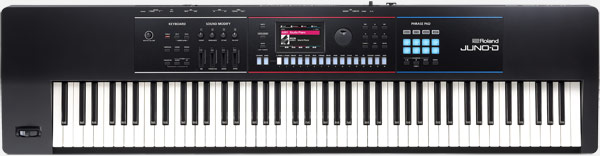
The JUNO-D8’s matte-black finish, textured side panels, and recessed control surface project a utilitarian confidence. At 1,146 mm wide, 329 mm deep, 109 mm high, and 12.5 kg, it fits comfortably on a single-tier X-stand and loads easily into a standard 76-key gig bag. The chassis feels rigid with no panel flex, and the control knobs have a reassuring detent.
The front panel is logically organized: a 3.5-inch color LCD (320 x 240) sits above eight category buttons (Piano, E.Piano, Organ, Synth, Strings, Pad, Bass, Other) for instant sound selection. Eight assignable sliders, a pitch bend/modulation lever, and a dedicated master volume knob provide tactile control. The transport section (Play, Stop, Rec) and phrase pad buttons (16 pads, 4 banks) are positioned for thumb access while playing.
Connectivity covers the essentials: balanced 1/4-inch L/Mono and R outputs, headphone jack, dual pedal inputs (damper + assignable), MIDI In/Out, USB Type-B for computer connectivity (audio 2-in/2-out, MIDI), and USB Type-A for memory. The inclusion of balanced outputs is a professional touch at this price point, allowing long cable runs to FOH without noise.
Keybed and Action: 76-Key Semi-Weighted
The JUNO-D8 employs a 76-key semi-weighted keyboard with velocity sensitivity and channel aftertouch. The action uses a spring-return mechanism with a moderate key dip (~12 mm) and a slightly textured keytop surface.
For piano playing, the semi-weighted action provides more resistance than a pure synth action but lacks the graded hammer response of Roland’s PHA or GHS keyboards. It’s serviceable for electric piano and organ, where a lighter touch is often preferred, but acoustic piano passages reveal the absence of progressive weighting—the bass keys feel the same as the treble.
For synth leads, organ glissandi, and fast rhythmic playing, the action excels. The quick return and moderate resistance facilitate rapid passages, and the channel aftertouch adds expressive control for filter sweeps and vibrato on compatible sounds. The 76-note range (E1–G7) covers most performance needs while saving 12 keys of width and weight versus an 88-key model.
Three velocity curves (Light, Medium, Heavy) plus Fixed accommodate different playing styles and external MIDI controller calibration.
Sound Engine: ZEN-Core
The JUNO-D8 is built on Roland’s ZEN-Core synthesis engine—the same core technology found in the FANTOM, JUPITER-X, and JUNO-X series. ZEN-Core combines PCM sample playback with virtual analog modeling, supporting up to 4 partials per tone, each with independent oscillator, filter, amplifier, envelopes, LFOs, and a modulation matrix.
The tone library exceeds 3,800 preset tones across categories:
– Acoustic Pianos (concert grands, uprights, vintage)
– Electric Pianos (Rhodes, Wurlitzer, FM, CP-style)
– Organs (tonewheel, transistor, pipe, combo)
– Synths (analog modeled, wavetable, FM, modern)
– Strings/Orchestral (solo, section, pads)
– Brass/Winds (solo, section, synth brass)
– Pads/Atmospheres (evolving, cinematic)
– Bass (acoustic, electric, synth)
– Drums/Percussion (kits, loops, one-shots)
– World/Folk (ethnic instruments, plucked, percussive)
Expansion memory (256 MB) allows loading additional waveform data via USB, with Roland providing free expansion packs (EXZ series) for specific genres and vintage recreations.
Each tone can be edited deeply: oscillator type (PCM, VA, SuperSAW, Noise), filter (24/12 dB LP/HP/BP, resonance, drive), dual envelopes (amp/filter), dual LFOs, step LFO, and a 16-source modulation matrix. The Tone Category system organizes sounds by musical role rather than synthesis type, accelerating sound selection during live performance.
Polyphony and Performance
128-note polyphony is generous for a workstation at this price tier. In practice, this supports dense layering (piano + pad + strings), sustained chords with heavy damper pedal, and complex drum/percussion parts without voice stealing. The engine prioritizes note retention intelligently—releasing the oldest notes first when the limit is approached.
The Phrase Pad section provides 16 velocity-sensitive pads × 4 banks = 64 phrases. Phrases can be recorded in real-time, step-sequenced, or imported as MIDI files. They sync to master tempo and can be triggered chromatically or as one-shots. This is a powerful tool for live looping, backing tracks, and on-the-fly arrangement building.
The Pattern Sequencer offers 100 patterns with 16 tracks each, 120 ppq resolution, real-time and step recording, and parameter automation. Patterns can be chained into songs. The Audio Recorder captures stereo WAV (44.1 kHz/16-bit) directly to USB memory.
Connectivity and Workflow
USB Type-B provides 2-in/2-out audio interface functionality (44.1 kHz/24-bit) with class-compliant drivers. This enables direct recording of the JUNO-D8’s output to a DAW and monitoring of DAW playback through the keyboard’s outputs—essential for studio integration.
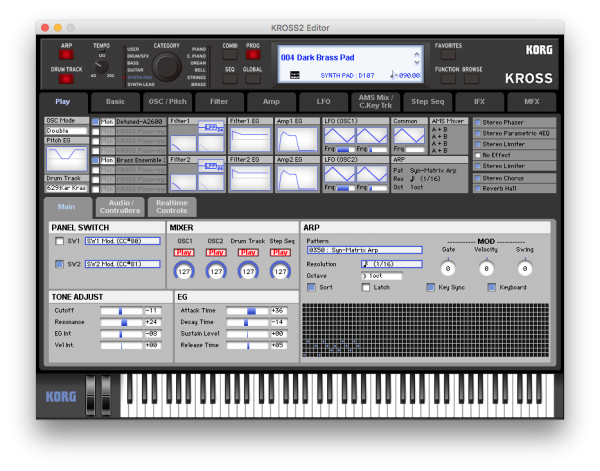
JUNO-D Editor (standalone/VST3/AU) provides visual editing of all parameters, tone librarian functions, and backup/restore. The editor communicates bidirectionally with the hardware via USB MIDI.
Roland Cloud integration allows browsing and downloading expansion content directly on the hardware (with Wi-Fi adapter) or via computer.
The Function button + category shortcuts provide instant access to commonly used parameters: split point, layer balance, effect send levels, arpeggiator on/off, and more—without menu navigation.
Effects and Processing
The effects architecture is practical and stage-focused:
– MFX (Multi-Effects): 90 types (distortion, phaser, flanger, rotary, amp sim, etc.) assignable per part (16 parts total)
– Reverb: 10 types + 10 user (Hall, Room, Plate, Spring, etc.)
– Chorus/Delay: 10 types + 10 user
– Master EQ: 4-band parametric
– Master Compressor: 3 types
– Part EQ: 3-band per part
MFX can be routed in series or parallel per part, with independent send levels to Reverb and Chorus. The MFX library includes emulations of classic Roland rack units (SDD-320, RE-201, VP-330 chorus) derived from the same VCM technology used in flagship models.
Live Performance Features
The JUNO-D8’s live workflow centers on Scenes (100 user) that store complete keyboard state: tone selections, splits/layers, effect settings, arpeggiator, phrase pad assignments, and controller mappings. Scene switching is near-instantaneous with held-note sustain across changes.
Live Set mode organizes scenes into setlists (16 sets × 16 scenes) for one-button progression through a gig. Favorites (64 slots) provide direct access to individual tones.
The Arpeggiator offers 128 preset patterns + 16 user, with tempo sync, latch, keyboard range, and step resolution. Chord Memory stores up to 8 voicings for single-finger triggering.
Pitch Bend/Mod Lever combines both functions in a single spring-return lever—a space-saving design that works well for synth leads but limits independent pitch/mod control.
Specifications Summary
| Category | Specification |
|———-|—————|
| Keyboard | 76-key semi-weighted, velocity sensitive, channel aftertouch |
| Sound Engine | ZEN-Core (PCM + Virtual Analog) |
| Maximum Polyphony | 128 notes |
| Preset Tones | 3,800+ |
| Wave Memory | 256 MB expansion (built-in) + USB |
| Effects | MFX (90 types, per part), Reverb (10+10), Chorus (10+10), Master EQ (4-band), Master Compressor |
| Sequencer | Pattern (100 x 16 tracks), Phrase Pad (64 phrases), Audio Recorder (WAV 44.1/16) |
| Audio Interface | USB: 2-in/2-out @ 44.1 kHz/24-bit |
| Display | 3.5-inch color LCD (320 x 240) |
| Dimensions (W x D x H) | 1,146 x 329 x 109 mm (45-1/8 x 12-15/16 x 4-3/8 in) |
| Weight | 12.5 kg (27 lbs 9 oz) |
| Power | 12 W (AC adapter) |
Value and Verdict
The Roland JUNO-D8 occupies a compelling niche: it delivers 90% of the professional workstation experience at roughly half the price and weight of a flagship. For the keyboardist who plays cover bands, wedding gigs, church services, or studio sessions, the JUNO-D8 provides instant access to thousands of production-ready sounds, a functional phrase/loop workflow, and reliable stage operation.
The compromises are deliberate and acceptable: the semi-weighted keybed won’t satisfy classical pianists; the 3.5-inch LCD is smaller than flagship touchscreens; the MFX architecture is less deep than the FANTOM’s insertion effects; expansion memory is limited to 256 MB. But for the target user—gigging musicians who need breadth, speed, and reliability—the JUNO-D8 hits the mark.
Pros:
– 3,800+ ZEN-Core tones cover every musical genre
– 128-note polyphony handles dense layering
– 12.5 kg weight is genuinely portable for 76 keys
– Balanced 1/4-inch outputs for professional stage use
– Phrase pads and pattern sequencer enable live looping/arranging
– USB audio/MIDI interface for studio integration
– Scene/Live Set workflow optimized for setlist performance
– Free expansion packs via Roland Cloud
Cons:
– Semi-weighted keybed lacks graded hammer feel for piano
– 256 MB expansion memory limits custom waveform loading
– 3.5-inch LCD requires menu diving for deep editing
– Combined pitch bend/mod lever limits independent control
– No aftertouch on all sounds (channel aftertouch only)
– Single MFX per part (vs. dual insertion on flagships)
Bottom Line: The Roland JUNO-D8 is the smart choice for working keyboardists who need professional sounds, stage-ready workflow, and genuine portability without flagship expenditure. It delivers exceptional value per kilogram and per dollar.
Check current price and availability: View on zZounds