Introduction
The Yamaha MODX M8 sits at the intersection of stage piano authenticity and synthesizer depth. As the 88-key flagship of the MODX M series, it combines a Graded Hammer Standard (GHS) keyboard with Yamaha’s Motion Control Synthesis Engine—delivering AWM2, FM-X, and AN-X engines with 268-note total polyphony in a 13.6 kg package that’s light enough for solo transport but substantial enough for serious stage work.
This review evaluates whether the MODX M8 successfully bridges the pianist’s need for weighted action with the synthesist’s demand for deep sound design.
Design and Build Quality
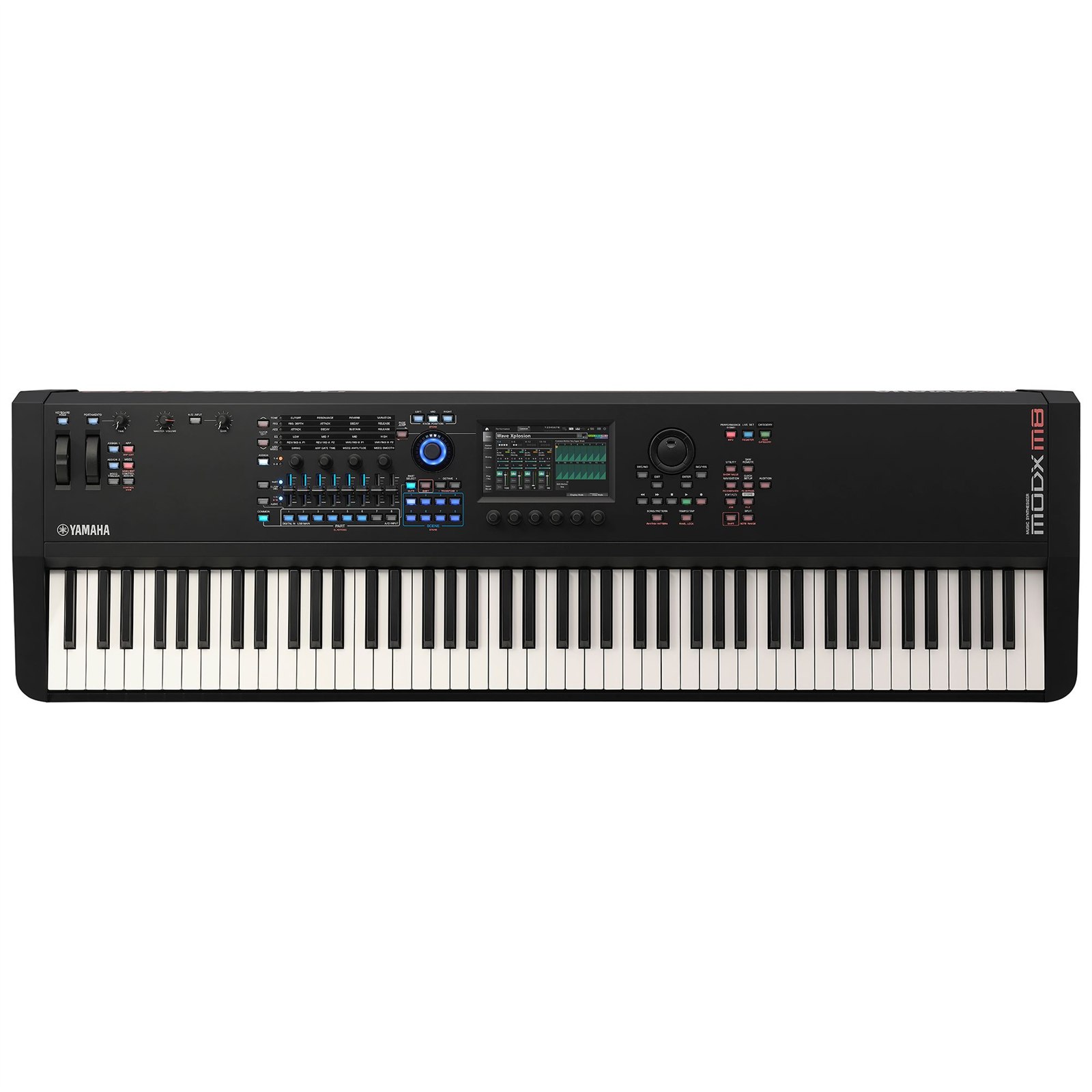
The MODX M8 presents a refined, purpose-built aesthetic: matte-black finish, aluminum front panel, and a 7-inch color touchscreen centered above a comprehensive control surface. At 1,310 mm wide, 391 mm deep, 152 mm high, and 13.6 kg, it’s remarkably light for an 88-key hammer-action workstation—easily managed by one person for gig transport.
The control surface mirrors the MONTAGE M architecture: eight assignable faders, four rotary encoders (vs. eight on MONTAGE), a Super Knob, six display knobs, pitch bend/modulation wheels, and dedicated transport/arpeggiator buttons. The reduction to four encoders is a sensible cost/space trade-off; the Super Knob and display knobs cover most real-time control needs.
Connectivity is stage-ready: 1/4-inch L/Mono and R outputs, headphone jack, dual pedal inputs (damper + assignable), expression pedal input, MIDI In/Out, USB Type-A (memory), USB Type-C (computer connectivity, audio 4-in/10-out @ 44.1 kHz), and DC power input. The absence of XLR outputs (present on MONTAGE) is notable but understandable at this price point; DI boxes or the balanced 1/4-inch outputs suffice for most stage scenarios.
Keybed and Action: 88-Key GHS (Graded Hammer Standard)
The MODX M8 features Yamaha’s GHS (Graded Hammer Standard) keyboard with 88 keys, graded weighting, and initial touch. The action uses a hammer mechanism with shorter pivots and lighter counterweights than the PHA-50 (found on MONTAGE), resulting in a lighter overall touch that’s more forgiving for extended synth playing sessions.
For piano playing, the GHS action delivers a credible acoustic response: graded weighting across the compass (heavier in the bass, lighter in the treble), velocity sensitivity that translates dynamic intention accurately, and a mechanical feel that encourages proper technique. It’s not the equal of the PHA-50 or premium console actions (GH3, NWX), but for a stage synth/workstation at this price, it’s remarkably good.
For synth leads, organ glissandi, and fast rhythmic playing, the lighter touch is actually advantageous—less mass to move, quicker return. The action does not support aftertouch (neither channel nor polyphonic), which limits expressive control on sustained notes compared to the MONTAGE’s FSX action.
Four touch sensitivity curves (Light, Medium, Heavy, Fixed) accommodate different playing styles and external controller calibration.
Sound Engine: Motion Control Synthesis Engine
The MODX M8 runs the same Motion Control Synthesis Engine as the MONTAGE M series, combining three engines with slightly reduced polyphony allocations:
AWM2 — 128 elements per part, 128-note polyphony (stereo/mono waveforms). Preset wave memory: 11.29 GB (16-bit linear equivalent). User flash memory: 1.9 GB for custom samples/expansions.
FM-X — 8 operators, 88 algorithms, 128-note polyphony. Same algorithm set as MONTAGE, enabling the same complex FM timbres.
AN-X — 3 oscillators, 1 noise source, 12-note polyphony (vs. 16 on MONTAGE). Same analog modeling architecture with component-level circuit behavior.
The three engines operate simultaneously within a single Performance (up to 16 parts). Seamless Sound Switching (SSS) sustains held notes and effect tails across Performance changes. Motion Sequencer, Envelope Follower, and Super Knob provide the same deep real-time control architecture as MONTAGE.
Polyphony and Performance
Total polyphony: 268 notes (AWM2: 128 + FM-X: 128 + AN-X: 12). This is ample for dense layering scenarios: piano (32) + pad (24) + strings (24) + bass (8) + drums (16) + synth lead (8) = 112 notes, well within limits.
The Pattern Sequencer (128 patterns × 16 tracks, 480 ppq), Song Sequencer (128 songs), and Performance Recorder (audio + MIDI to USB) mirror MONTAGE capabilities. Performance Slots (3,487) provide massive storage for complete setups.
Effects and Processing
Effects architecture is shared with MONTAGE: Insertion A/B (363 types), Variation, Reverb/Chorus (master), Master Compressor/EQ, Part EQ (28 parts), VCM modeling of classic Yamaha processors. The reduction to four physical encoders (vs. eight) means more touchscreen interaction for deep effect editing, but the Super Knob and display knobs cover most performance adjustments.
Connectivity and Workflow
USB-C provides 4-in/10-out audio interface at 44.1 kHz (2-in/2-out at 48/96 kHz), class-compliant drivers. DAW Remote maps to major DAWs. MODX M Editor (VST3/AU/standalone) provides visual editing. Yamaha Expansion Manager handles content via USB (no internal Wi-Fi/Ethernet—requires computer or USB Wi-Fi adapter).
Specifications Summary
| Category | Specification |
|———-|—————|
| Keyboard | 88-key GHS (Graded Hammer Standard), graded weighting, initial touch |
| Sound Engines | AWM2 (128 elements), FM-X (8 ops, 88 algos), AN-X (3 osc, 1 noise) |
| Maximum Polyphony | AWM2: 128, FM-X: 128, AN-X: 12 (total 268) |
| Preset Wave Memory | 11.29 GB (16-bit linear equivalent) |
| User Flash Memory | 1.9 GB |
| Effects | Insertion A/B (363), Variation, Reverb/Chorus, Master Comp/EQ, Part EQ, VCM |
| Sequencer | Pattern (128 x 16), Song (128), 480 ppq |
| Audio Interface | USB-C: 4-in/10-out @ 44.1 kHz; 2-in/2-out @ 48-96 kHz |
| DAW Remote | Logic, Live, Cubase, Pro Tools, Studio One, Reaper, DP, Cakewalk, Reason |
| Display | 7″ TFT Color Wide VGA (800 x 480) touch |
| Dimensions (W x D x H) | 1,310 x 391 x 152 mm (51-9/16 x 15-3/8 x 5-15/16 in) |
| Weight | 13.6 kg (29 lbs 15 oz) |
| Power | 19 W (PA-300C adapter) |
Value and Verdict
The Yamaha MODX M8 occupies a unique sweet spot: it’s the only 88-key hammer-action workstation that delivers three synthesis engines (AWM2, FM-X, AN-X), Motion Control real-time control, and professional DAW integration at a sub-14 kg weight and mid-four-figure price. For the pianist-synthesist hybrid who needs authentic piano action on stage and deep sound design in the studio, the MODX M8 is a compelling singular solution.
The compromises are deliberate: GHS action is lighter than premium piano actions; no aftertouch; 12-note AN-X polyphony limits analog modeling complexity; no XLR outputs; no internal Wi-Fi/Ethernet; four encoders vs. eight on MONTAGE. But these trade-offs enable the weight, price, and feature balance that makes the MODX M8 uniquely versatile.
Pros:
– 88-key GHS graded hammer action suitable for piano and synth
– Full Motion Control Synthesis Engine (AWM2 + FM-X + AN-X)
– 268-note total polyphony handles dense layering
– 13.6 kg weight is remarkably portable for 88-key hammer action
– Seamless Sound Switching for glitch-free live changes
– 4-in/10-out USB audio interface with DAW Remote
– VCM effects model classic Yamaha processors
– 1.9 GB user flash memory for custom samples
– Deep computer integration (Editor, Expansion Manager, DAW Remote)
Cons:
– GHS action lighter than premium piano actions (PHA-50, GH3, NWX)
– No aftertouch (channel or polyphonic)
– AN-X limited to 12-note polyphony
– No XLR outputs
– No internal Wi-Fi/Ethernet (requires computer/USB adapter for expansions)
– Four encoders vs. eight on MONTAGE M series
– 1.9 GB user flash smaller than MONTAGE’s 3 GB expansion
Bottom Line: The Yamaha MODX M8 is the most complete stage-ready synthesis solution for the pianist who also needs deep synth capabilities. It delivers 90% of the MONTAGE M experience at 60% of the weight and a significantly lower price—making it the pragmatic choice for working keyboardists who bridge piano and synthesis worlds.