Introduction
The Yamaha Genos2 arrives as the definitive flagship in the arranger workstation category, building on the revolutionary Genos platform with FM synthesis expansion, enhanced polyphony, and a redesigned user interface. As the only arranger workstation to integrate FM synthesis alongside AWM stereo sampling and AEM (Articulation Element Modeling), the Genos2 targets the solo entertainer, one-man-band performer, and studio arranger who demands the widest sonic palette and most expressive control surface in a single instrument.
This review examines whether the Genos2’s evolutionary upgrades justify its flagship positioning and whether the FM integration meaningfully expands creative possibilities for arranger-based music production.
Design and Build Quality
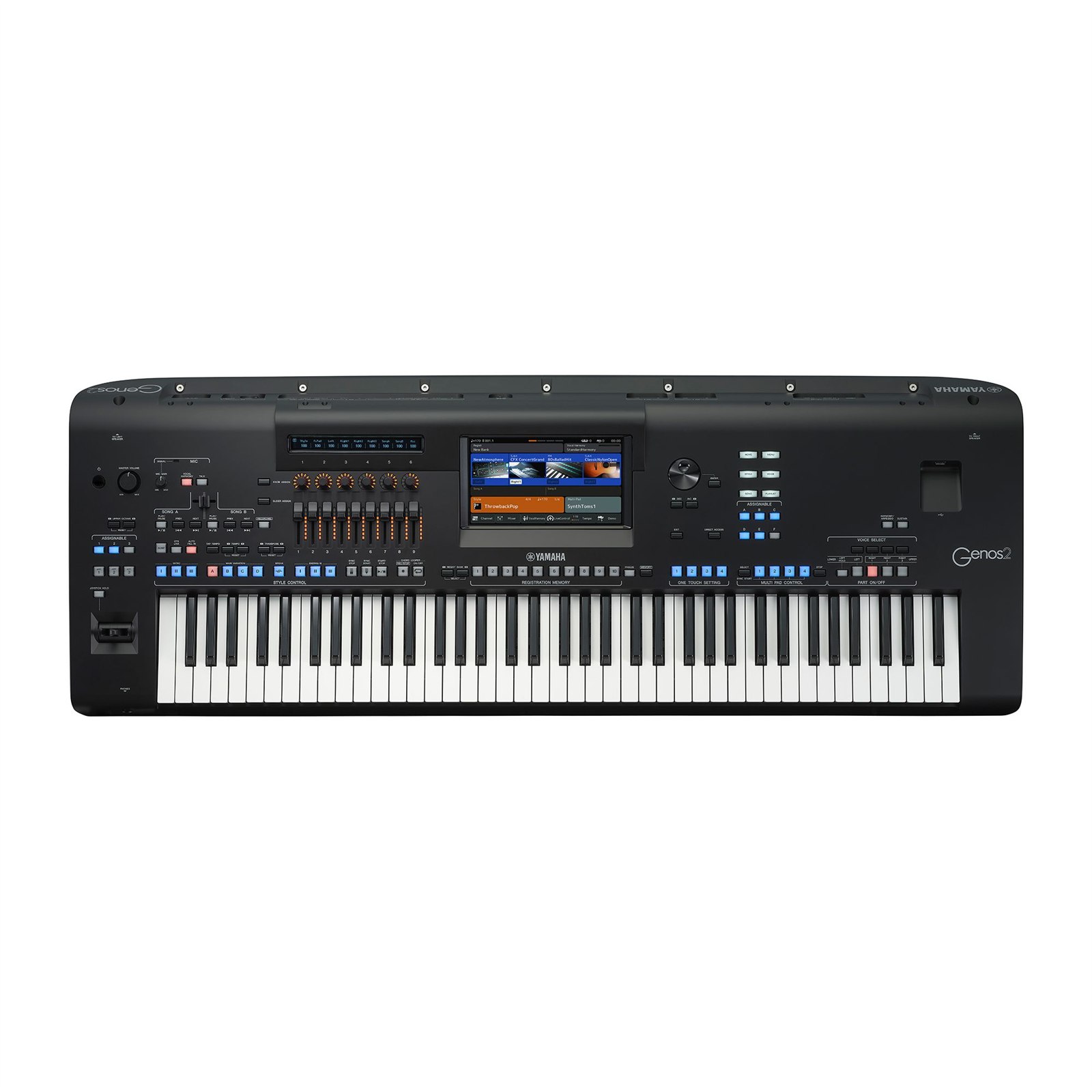
The Genos2 presents a premium, stage-ready aesthetic: matte-black finish with brushed aluminum accents, a 9-inch anti-reflective color touchscreen (800 x 480), and a dedicated sub-display VA LCD (LIVE CONTROL View) for real-time parameter feedback. At 1,234 mm wide, 456 mm deep, 151 mm high, and 14.2 kg, it commands presence without being unwieldy—two-person transport recommended but manageable.
The control surface is the most comprehensive in the arranger class: six assignable knobs with LED gauges, nine assignable sliders with LED gauges + crossfader, nine assignable buttons (A–F, 1–3), three articulation buttons (ART. 1/2/3), a joystick, and physical LED drawbars for organ control. Every control feels substantial with precise detents. The anti-reflective touchscreen is bright, responsive, and readable under direct stage lighting.
Connectivity is exhaustive: 1/4-inch L/Mono and R outputs, two assignable 1/4-inch outputs, headphone jack, dual pedal inputs (damper + assignable), expression pedal input, MIDI In/Out, two USB Type-A ports (memory + Wi-Fi), USB Type-B (computer connectivity), HDMI output, Ethernet, and wireless LAN. The inclusion of HDMI and Ethernet reflects the Genos2’s role as a multimedia performance hub.
Keybed and Action: 76-Key FSX Organ with Aftertouch
The Genos2 features a 76-key FSX (Factory Standard Extended) Organ keyboard with initial touch and channel aftertouch. The action uses a spring-return mechanism optimized for organ and synth playing: moderate key dip, quick return, and a slightly textured keytop surface.
For organ playing, the FSX action is exemplary: the moderate resistance and quick return facilitate glissandi, palm smears, and rapid registration changes. Channel aftertouch adds expressive control for Leslie speed, vibrato depth, and filter modulation on compatible voices.
The 76-key range (E1–G7) covers the full practical range for arranger performance: left-hand bass/chord splits typically reside below C3, right-hand melody/lead above. The missing bottom octave (A0–D#1) and top half-octave (G#7–C8) are rarely used in arranger repertoire.
Three touch curves (Normal, Easy1, Easy2, Soft1, Soft2, Hard1, Hard2) accommodate diverse playing styles.
Sound Engine: AWM + AEM + FM (Triple Architecture)
The Genos2’s headline advancement is FM synthesis integration alongside the established AWM Stereo Sampling and AEM (Articulation Element Modeling) technologies:
AWM Stereo Sampling — Yamaha’s flagship sample engine with stereo multisamples, velocity layers, key-off samples, and alternate groups. The preset library exceeds 1,991 voices + 75 drum/SFX kits + 480 XG voices.
AEM (Articulation Element Modeling) — Behavioral modeling of instrument-specific articulations: string resonance, bow direction, breath noise, fret noise, hammer noise, and legato transitions. AEM voices (S.Articulation, S.Articulation+, S.Articulation2) respond to playing technique with context-appropriate nuances.
FM Synthesis — New to Genos2, the FM engine adds 128-voice polyphony with 8-operator algorithms, spectral forms, and resonator operators. FM excels at electric pianos, metallic pads, bell-like tones, and aggressive synth leads that are difficult to achieve with sample-based engines alone.
The three engines operate simultaneously within a single Registration (up to 16 parts: 3 right-hand, 1 left-hand, 12 style/accompaniment). Seamless Sound Switching sustains held notes across registration changes.
Polyphony and Performance
Total polyphony: 384 voices (128 Preset AWM + 128 Expansion AWM + 128 FM). This is the highest polyphony in the arranger class, eliminating voice stealing even with dense style accompaniment, layered right-hand voices, and sustained pedal notes.
Styles: 800 total (720 Pro, 69 Session, 11 Free Play) with Style Dynamics Control for real-time energy shaping. Chord Looper records chord progressions for hands-free accompaniment. Multi Pads (4 banks × 4) provide phrase-based embellishments.
Sequencer: MIDI song recording/playback (16 tracks, 480 ppq), audio recording/playback (WAV 44.1/24-bit to USB). Playlist organizes registrations into setlists for instant recall.
Effects and Processing
Effects architecture is arranger-optimized: Reverb (85 preset + 30 user), Chorus (107 preset + 30 user), DSP Variation (363 preset + 30 user), Insertion Effects 1–28 (363 preset + 30 user each), Master Compressor (5 + 30), Master EQ (9 + 30, 5-band), Part EQ (28 parts, 3-band), Vocal Harmony (54 preset + 60 user), Synth Vocoder (20 + 60), Mic Effect (noise gate, compressor, 3-band EQ, vocal effects). The REVelation Reverb (Steinberg-licensed) and Multiband Compressor insertion effects are new to Genos2.
Connectivity and Workflow
USB Audio Interface: 44.1 kHz/24-bit, stereo in/out. HDMI outputs touchscreen content to external monitor. Ethernet/Wireless LAN for Yamaha Expansion Manager content downloads and network integration. USB Type-A ×2 for memory and Wi-Fi adapter. Wireless LAN built-in.
Expansion: ~3 GB internal memory for voice/style/audio expansions. Yamaha Expansion Manager (computer) or direct Wi-Fi download.
Specifications Summary
| Category | Specification |
|———-|—————|
| Keyboard | 76-key FSX Organ, initial touch, channel aftertouch |
| Sound Engines | AWM Stereo Sampling, AEM, FM |
| Maximum Polyphony | 384 (128 Preset AWM + 128 Expansion AWM + 128 FM) |
| Preset Voices | 1,991 + 75 Drum/SFX Kits + 480 XG |
| Featured Voices | 106 S.Art2, 437 S.Art, 141 FM, 123 MegaVoice, 24 OrganFlutes, 11 Ambient Drums, 11 Revo Drums |
| Styles | 800 (720 Pro, 69 Session, 11 Free Play) |
| Effects | Reverb 85+30, Chorus 107+30, DSP Var 363+30, Ins 1-28 363+30, Master Comp/EQ, Part EQ, Vocal Harmony, Vocoder, Mic FX |
| Sequencer | MIDI (16 trk), Audio (WAV 44.1/24), Playlist |
| Display | 9″ TFT Color Wide VGA (800×480) anti-reflection touch + VA LCD (512×48) LIVE CONTROL View |
| Dimensions (W x D x H) | 1,234 x 456 x 151 mm (48-9/16 x 17-15/16 x 5-15/16 in) |
| Weight | 14.2 kg (31 lbs 5 oz) |
| Power | 35 W (PA-300C adapter) |
Value and Verdict
The Yamaha Genos2 is not merely an incremental update—it’s a strategic expansion of the arranger workstation concept. By integrating FM synthesis, Yamaha addresses the one sonic territory where sample-based arrangers traditionally struggled: aggressive synth leads, metallic timbres, and evolving FM pads that breathe with authentic harmonic motion. For the solo entertainer who needs to cover pop, rock, jazz, EDM, and cinematic styles in a single night, the Genos2’s triple-engine palette is unprecedented.
The compromises are few: 76 keys limit classical piano repertoire; 14.2 kg requires two-person transport; price is flagship-tier; learning curve for triple-engine architecture is steep. But for the professional arranger performer who builds a livelihood on sonic versatility and real-time control, the Genos2 is the current category benchmark.
Pros:
– Triple-engine architecture (AWM + AEM + FM) unique in arranger class
– 384-note polyphony eliminates voice stealing in dense arrangements
– 1,991+ voices with S.Articulation2, FM, and MegaVoice coverage
– 800 styles with Style Dynamics Control and Chord Looper
– 9-inch anti-reflective touchscreen + dedicated sub-display
– Physical LED drawbars + 6 knobs/9 sliders/9 buttons for real-time control
– REVelation Reverb (Steinberg) and Multiband Compressor insertion effects
– HDMI, Ethernet, Wireless LAN for modern connectivity
– Vocal Harmony and Synth Vocoder built-in
Cons:
– 76-key range limits classical piano repertoire
– 14.2 kg weight requires two-person transport
– Premium flagship price
– Steep learning curve for triple-engine + arranger workflow
– No XLR outputs (1/4-inch only)
– Expansion memory limited to ~3 GB internal
Bottom Line: The Yamaha Genos2 redefines the arranger workstation ceiling by adding FM synthesis to the AWM/AEM foundation. For the professional solo entertainer, one-man-band producer, or studio arranger who needs the widest sonic palette and most expressive control surface in a single instrument, the Genos2 stands alone at the summit.