Introduction
The Yamaha MONTAGE M6 represents the most portable entry point into Yamaha’s flagship Motion Control Synthesis lineup. While the MONTAGE M8x (88-key) and M7 (76-key) target players needing full piano range, the M6’s 61-key FSX keyboard with channel aftertouch makes it the choice for synth players, sound designers, and performing keyboardists who prioritize sound depth and control surface over keyboard span. At 15.3 kg, it’s the lightest MONTAGE M model by a significant margin.
This review examines whether the M6’s reduced key count compromises the Motion Control experience or distills it to its most expressive essence.
Design and Build Quality
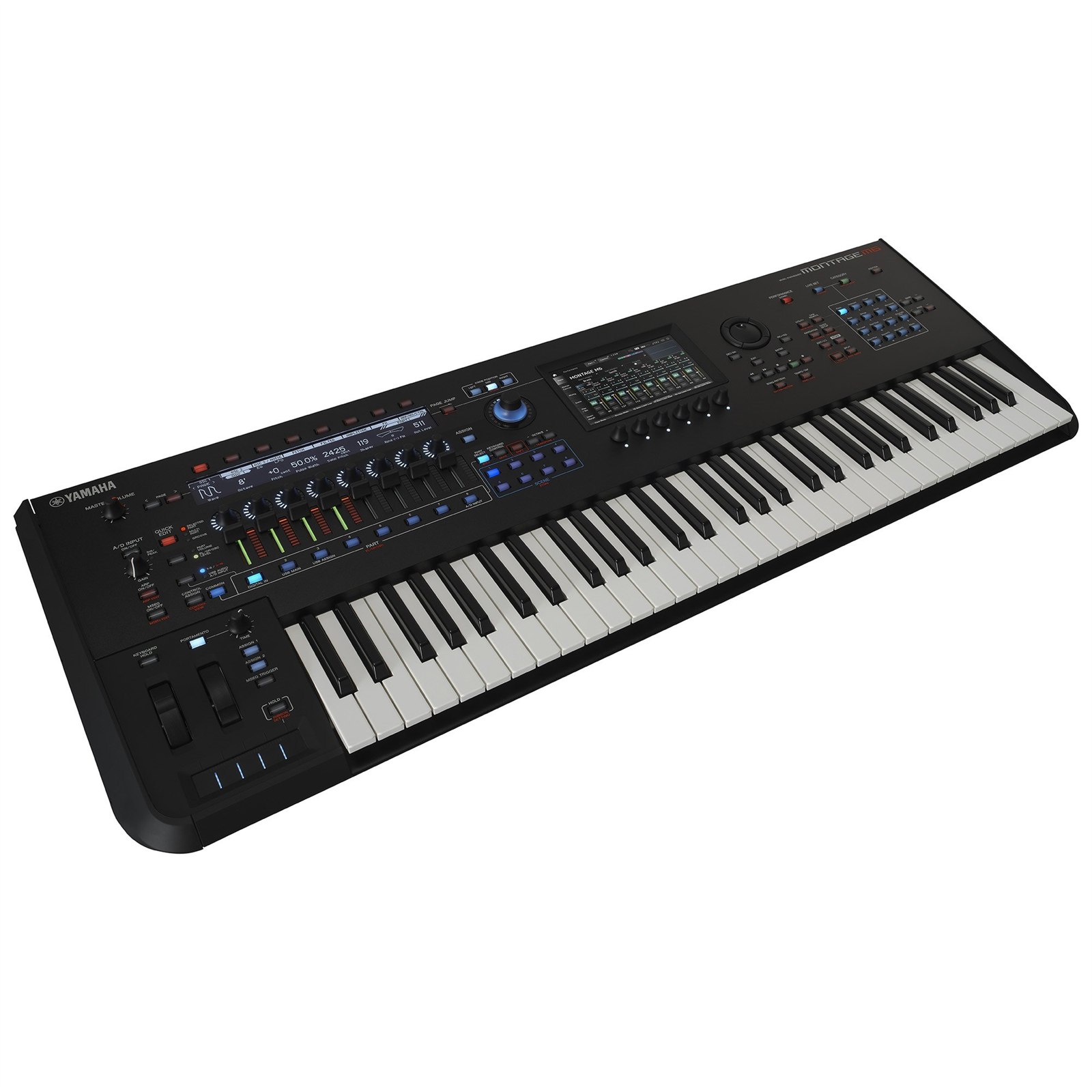
The MONTAGE M6 shares the M-series design language: brushed aluminum top panel, matte-black side cheeks, and a 7-inch color touchscreen that serves as the primary navigation interface. At 1,037 mm wide, 396 mm deep, 131 mm high, and 15.3 kg, it fits comfortably on a single-tier stand with room for a laptop or controller beside it.
The control surface is comprehensive: eight assignable faders, eight rotary encoders, a Super Knob, six display knobs, pitch bend/modulation wheels, a ribbon controller, and dedicated transport/arpeggiator buttons. Every control feels precise with a satisfying detent. The touchscreen is responsive, bright, and readable at extreme angles—essential for stage visibility.
Connectivity is professional-grade: balanced XLR outputs (with ground lift), 1/4-inch main L/R outputs, two assignable 1/4-inch outputs, headphone jack, dual pedal inputs (damper + assignable), expression pedal input, MIDI In/Out/Thru, two USB Type-A ports, USB Type-C for computer connectivity, and Ethernet. The inclusion of analog XLR outputs with ground-lift capability addresses a common pain point in venue installations.
Keybed and Action: 61-Key FSX with Channel Aftertouch
The MONTAGE M6 features Yamaha’s FSX (Factory Standard Extended) keyboard with 61 keys, initial touch, and channel aftertouch. The action uses a spring-return mechanism with a moderate key dip and a slightly textured keytop surface.
For synth playing, the FSX action excels: the moderate resistance and quick return facilitate fast runs, glissandi, and rhythmic comping. Channel aftertouch adds expressive control for filter sweeps, vibrato, and modulation on compatible sounds—particularly valuable with the AN-X analog modeling engine where aftertouch can drive filter cutoff, oscillator pitch, or LFO depth.
The 61-key range (C2–C7) covers the vast majority of lead, pad, and comping duties. For two-handed piano playing, the range is limiting (missing the bottom octave and top half-octave), but split/layer workflows mitigate this effectively: left-hand bass split below C3, right-hand synth/lead above.
Three touch sensitivity curves (Normal, Soft, Hard) plus Fixed accommodate different playing styles.
Sound Engine: Motion Control Synthesis Engine
The MONTAGE M6 runs the identical Motion Control Synthesis Engine as its larger siblings, combining three distinct engines:
AWM2 (Advanced Wave Memory 2) — Yamaha’s flagship sample-based engine with 128 elements per part, stereo/mono waveforms, and 256-note polyphony (max). The preset library exceeds 10 GB (when converted to 16-bit linear), covering acoustic pianos, electric pianos, organs, strings, brass, pads, and more with velocity layers, key-off samples, and alternate groups.
FM-X — Yamaha’s modern FM synthesis engine with 8 operators, 88 algorithms, and 128-note polyphony. FM-X extends traditional FM with spectral forms, resonator operators, and a sophisticated modulation matrix. The 8-operator architecture enables complex timbres impossible on 6-operator DX-era synths.
AN-X — Yamaha’s new analog modeling engine with 3 oscillators, 1 noise source, and 16-note polyphony. AN-X models the non-linear behavior of classic analog circuits at the component level: oscillator drift, filter saturation, VCA compression, and envelope curve shaping. The result is a living, breathing analog voice that responds to parameter changes with authentic character.
The three engines operate simultaneously within a single Performance (up to 16 parts), with parts layerable, splittable, or zoned across the keyboard with crossfade transitions. Each part has independent effects routing, MIDI channel, and controller assignments.
Polyphony and Performance
Polyphony allocation is per-engine: AWM2: 256 (stereo/mono), FM-X: 128, AN-X: 16. In practical terms, this means you can layer a massive AWM2 pad (64 notes), an FM-X electric piano (32 notes), and an AN-X analog bass (16 notes) simultaneously without voice stealing. The total 256 + 128 + 16 architecture effectively eliminates polyphony anxiety.
Seamless Sound Switching (SSS) sustains held notes and effect tails across Performance changes—instantaneous (< 50 ms) with no audio glitches. This is critical for live performance where patch changes must not interrupt sustained chords or reverb trails. The Motion Sequencer provides tempo-synced, per-part parameter automation with up to 16 steps × 16 lanes, recordable in real-time or step mode. Envelope Follower derives control signals from audio input (A/D or USB) for dynamic modulation. Super Knob controls up to 128 parameters across all parts with a single gesture—ideal for dramatic filter sweeps, effect morphs, or layered timbral shifts. Effects and Processing Each of the 16 parts has dedicated effects: Insertion Effects A/B (363 types including VCM modeling of classic processors), Variation Effect (shared), Reverb (85 preset + 30 user), Chorus (107 preset + 30 user), Master Compressor (5 preset + 30 user), Master EQ (9 preset + 30 user, 5-band parametric), and Part EQ (28 parts, 3-band). The DSP Variation system provides 363 preset + 30 user algorithms for real-time sound shaping. VCM (Virtual Circuit Modeling) effects deserve special mention: they model the analog behavior of classic Yamaha processors at the circuit level, delivering the same non-linear response and harmonic richness as the hardware originals. Connectivity and Workflow Integration The MONTAGE M6 excels as a studio centerpiece. USB-C provides 4-in/32-out audio interface operation at up to 192 kHz/24-bit (6-in/8-out at 192 kHz), with class-compliant drivers for macOS, Windows, and iOS. The 6-input/32-output configuration at 44.1 kHz accommodates multitrack recording of the internal engines plus external sources simultaneously. DAW Remote mode maps the faders, encoders, and transport to major DAWs (Logic Pro, Ableton Live, Cubase, Pro Tools, Studio One, Reaper, Digital Performer, Cakewalk, Reason). The mapping is bi-directional: DAW parameter changes reflect on the MONTAGE's hardware controls, and vice versa. MONTAGE M Editor (VST3/AU/standalone) provides deep visual editing of every parameter on a computer screen, with full patch librarian functions. Patches created in the editor sync instantly to the hardware. Yamaha Expansion Manager allows direct browsing, auditioning, and downloading of expansion content (additional AWM2 waveforms, FM-X algorithms, AN-X models) over Wi-Fi or Ethernet. The 3 GB internal expansion memory can be supplemented via USB storage. Specifications Summary | Category | Specification | |----------|---------------| | Keyboard | 61-key FSX, initial touch, channel aftertouch | | Sound Engines | AWM2 (128 elements), FM-X (8 ops, 88 algos), AN-X (3 osc, 1 noise) | | Maximum Polyphony | AWM2: 256, FM-X: 128, AN-X: 16 (total 400) | | Preset Wave Memory | 10+ GB (16-bit linear equivalent) | | Expansion Memory | 3 GB internal + USB storage | | Effects | Insertion A/B (363 types), Variation, Reverb/Chorus, Master Comp/EQ, Part EQ (28), VCM | | Sequencer | Pattern (128 x 16 tracks), Song (128), 480 ppq | | Audio Interface | USB-C: 4-in/32-out @ 44.1 kHz; 6-in/8-out @ 192 kHz | | DAW Remote | Logic, Live, Cubase, Pro Tools, Studio One, Reaper, DP, Cakewalk, Reason | | Display | 7" TFT Color Wide VGA (800 x 480) touch + 128 x 64 sub OLED | | Dimensions (W x D x H) | 1,037 x 396 x 131 mm (40-13/16 x 15-9/16 x 5-3/16 in) | | Weight | 15.3 kg (33 lbs 12 oz) | | Power | 19 W (PA-300C adapter) | Value and Verdict The Yamaha MONTAGE M6 is not a compromised flagship—it's a deliberate form factor for players who need the full Motion Control architecture in the most portable package possible. For the synth player, sound designer, or touring keyboardist who rarely uses the bottom octave, the M6 delivers 100% of the M8x/M7 sound engine, polyphony, effects, sequencing, and DAW integration at 55% of the weight. The compromises are clear: 61 keys limit two-handed piano repertoire; no aftertouch on all sounds (channel only); no XLR outputs on some regional variants (check specs); 3 GB expansion memory may require USB storage for large libraries. But for the target user—sound designers, synth players, producers who work in a 5-octave range—the M6 is the most practical MONTAGE M. Pros: - Full Motion Control Synthesis Engine (AWM2 + FM-X + AN-X) identical to M8x/M7 - 400-note total polyphony eliminates voice stealing - 15.3 kg weight is genuinely portable for a flagship workstation - FSX keyboard with channel aftertouch excels at synth/organ playing - Seamless Sound Switching for glitch-free live changes - 4-in/32-out USB audio interface with DAW Remote - VCM effects model classic Yamaha processors authentically - Instant Performance switching with sustained tails - Deep computer integration (Editor, Expansion Manager, DAW Remote) Cons: - 61-key range limits two-handed piano playing - Channel aftertouch only (no polyphonic aftertouch) - 3 GB internal expansion memory may require USB supplementation - Premium price point - Learning curve for triple-engine architecture - No built-in speakers (by design for this class) Bottom Line: The Yamaha MONTAGE M6 proves that flagship synthesis doesn't require 88 keys. For the modern synthesist who values sound depth, control surface, and portability over keyboard span, the M6 delivers the complete Motion Control experience in the most transportable package Yamaha has ever offered at this level.