Introduction
The Korg KingKORG stands apart in the modern synthesizer landscape as a dedicated analog modeling instrument with a built-in vocoder, XMT (eXpanded Modeling Technology) engine, and a control surface designed for immediate, hands-on sound design. At 7.0 kg with a 61-key semi-weighted keyboard, XLR mic input, and CV/GATE output, the KingKORG targets synthesists, sound designers, and live performers who want analog-style immediacy without the maintenance vagaries of true vintage hardware.
This review evaluates whether the KingKORG’s modeling depth and vocoder integration justify its position as Korg’s flagship analog modeling synthesizer.
Design and Build Quality
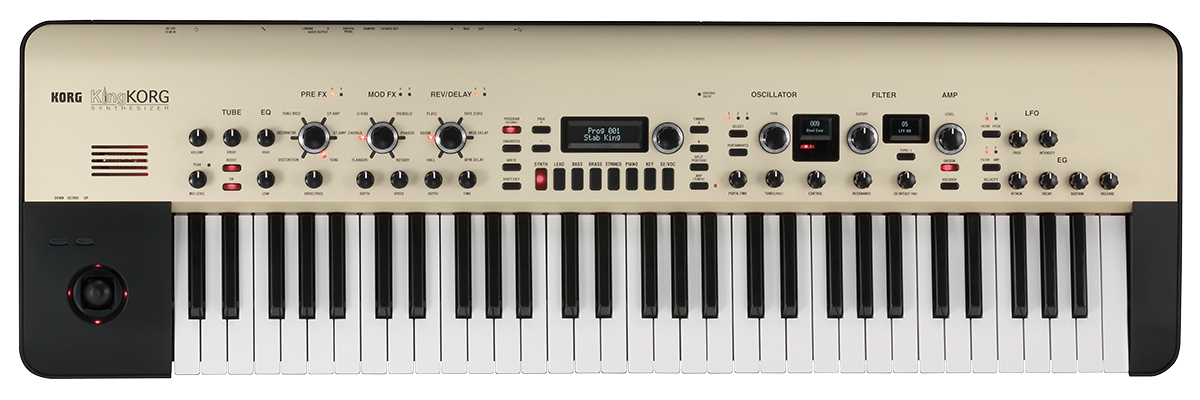
The KingKORG projects a serious, instrument-for-instrumentalists aesthetic: matte-black metal chassis, aluminum front panel, and a dual-display layout (16×2 character OLED main + 128×64 pixel OLED sub-displays for oscillator/filter sections). At 1,027 mm wide, 313 mm deep, 96 mm high, and 7.0 kg, it’s substantial enough for stage stability but light enough for solo transport.
The control surface is the KingKORG’s defining feature: dedicated knobs for every major parameter (oscillator pitch/wave/shape, filter cutoff/resonance/type, amp/filter EG attack/decay/sustain/release, LFO rate/depth, virtual patch routing), plus a joystick, octave buttons, category/favorite buttons, and a vocoder mic gain knob. Every parameter has a physical control—no menu diving for core sound design. The OLED displays are bright, high-contrast, and readable at any angle.
Connectivity is professional: XLR mic input (balanced, +48V phantom), 1/4-inch L/Mono and R outputs, headphone jack (3.5 mm stereo), MIDI In/Out, USB Type-B, CV/GATE out (for monotribe/volca integration), Damper pedal, Switch/Pedal. The inclusion of CV/GATE and XLR mic input reflects the KingKORG’s dual identity as synth and vocoder.
Keybed and Action: 61-Key Semi-Weighted
The 61-key semi-weighted keyboard uses a spring-return mechanism with velocity sensitivity. It’s a competent synth action: moderate resistance, quick return, no aftertouch. The semi-weighted feel bridges synth lead playing and light piano passages adequately, though it lacks the graded hammer response of piano-focused actions.
For analog modeling synthesis—where parameter tweaking in real-time is the primary expressive modality—the keyboard serves its purpose: trigger notes, play chords, feed the vocoder. The absence of aftertouch is notable but consistent with the analog modeling paradigm where modulation is typically routed via joystick, LFO, EG, or virtual patches.
Sound Engine: XMT (eXpanded Modeling Technology)
XMT is Korg’s analog modeling technology that simulates the behavior of analog circuits at the component level—oscillator drift, filter non-linearities, VCA compression, envelope curve shaping—rather than using static samples or basic virtual analog algorithms.
Oscillators: 3 per timbre, choose from 127 types:
– Analog & Noise: 64 types (classic waveforms, PWM, sync, ring mod, cross-mod, noise)
– DWGS: 30 types (Digital Waveform Generation System—Korg’s proprietary wavetables)
– PCM: 50 types (multisamples for acoustic/exotic timbres)
– MIC IN: external audio as oscillator source (vocoder carrier, audio processing)
Filter: 1 per timbre, 18 types (7 LPF, 5 HPF, 6 BPF including modeling filters of classic Korg filters: MS-20, Polysix, Mono/Poly, etc.). Resonance with self-oscillation capability.
Modulation: 2 EG (Filter, Amp), 2 LFO, AMP EG, Virtual Patch: 6 sets per timbre (source → destination with intensity). Sources: EG, LFO, velocity, aftertouch, joystick, controllers. Destinations: pitch, filter, amp, LFO, effect params.
Vocoder: 16-band, formant shift, formant hold, mic input as modulator, oscillator as carrier. Dedicated mic gain knob and vocoder-specific controls.
Programs: 300 (200 Presets / 100 Users), 8 categories, max 2 timbres (Layer/Split). Maximum Polyphony: 24 voices.
Performance and Expression
The Joystick combines pitch bend (X-axis) and modulation (Y-axis) with a dedicated hold button. Virtual Patches (6 per timbre) enable complex modulation routings: EG → filter cutoff, LFO → oscillator pitch, velocity → amp level, joystick Y → filter resonance, etc.
Arpeggiator: Up to 8 steps, 6 types (UP, DOWN, ALT1, ALT2, RANDOM, TRIGGER), tempo sync, latch, range, gate time. Favorite function (8 slots) for instant program recall. Category buttons for rapid sound selection.
Effects: Program effects ×3 (PRE FX: 6 types including Distortion, Decimator, Ring Mod, GT Amp, EP Amp, Tone; MOD FX: 6 types including Flanger, Chorus, U-Vibe, Tremolo, Phaser, Rotary; REV/DELAY: 6 types including Hall, Room, Plate, Tape Echo, Mod Delay, BPM Delay) + EQ (2-band).
Connectivity and Workflow
CV/GATE Out enables integration with Korg’s monotribe, volca series, and modular gear—pitch CV + gate output from keyboard/sequencer. USB Type-B for MIDI and data backup. Korg Kontrol Editor (standalone) provides visual editing and librarian functions.
Specifications Summary
| Category | Specification |
|———-|—————|
| Keyboard | 61-key semi-weighted, velocity sensitive, no aftertouch |
| Sound Engine | XMT (eXpanded Modeling Technology) |
| Maximum Polyphony | 24 voices |
| Programs | 300 (200 Presets / 100 Users), 8 categories |
| Timbres | Max 2 (Layer / Split) |
| Oscillators | 3 per timbre, 127 types (Analog/Noise 64, DWGS 30, PCM 50, MIC IN) |
| Filter | 1 per timbre, 18 types (7 LPF, 5 HPF, 6 BPF incl. modeling) |
| Modulation | EG: 2, LFO: 2, Virtual Patch: 6 per timbre |
| Vocoder | 16-band, formant shift/hold, mic input |
| Effects | PRE FX (6), MOD FX (6), REV/DELAY (6), EQ (2-band) |
| Controllers | Joystick, Octave, Category/Favorite, Vocoder mic gain |
| Display | Main: 16×2 char OLED; Sub: 128×64 pixel OLED ×2 (Osc/Filter) |
| Connectivity | MIDI In/Out, USB Type B, Audio L/Mono/R (TS 6.3mm), Headphones (3.5mm), Mic In (XLR balanced), CV/GATE Out, Damper/Switch pedals |
| Dimensions | 1,027 x 313 x 96 mm (40.43 x 12.32 x 3.78 in) |
| Weight | 7.0 kg (15.43 lbs) |
| Power | AC Adapter DC 12V, 10 W |
Value and Verdict
The Korg KingKORG occupies a unique niche: it’s the only current-production synthesizer that combines deep analog modeling (XMT), a 16-band vocoder with XLR mic input, CV/GATE modular integration, and a fully hands-on control surface in a sub-7 kg package. For the synthesist who wants analog-style sound design immediacy, vocoder performance capability, and modular connectivity without vintage maintenance, the KingKORG is a singular solution.
The compromises are clear: 24-voice polyphony limits dense layering; 61-key semi-weighted action isn’t piano-grade; no aftertouch; only 2 timbres per program (vs. 16 on workstations); PCM oscillator types are supplemental, not primary; no built-in sequencer/arpeggiator beyond basic patterns. But these are the focused compromises that enable the analog modeling depth and control surface density.
Pros:
– XMT analog modeling with component-level circuit simulation
– 127 oscillator types covering analog, DWGS, PCM, MIC IN
– 16-band vocoder with formant shift/hold + XLR mic input
– 18 filter types including classic Korg model emulations
– 6 virtual patches per timbre for deep modulation routing
– CV/GATE out for modular/monotribe/volca integration
– Fully hands-on control surface: every parameter has a knob
– Dual OLED displays for parameter feedback
– 7.0 kg weight is stage-portable
Cons:
– 24-voice polyphony limits layering
– Only 2 timbres per program (Layer/Split)
– No aftertouch (channel or polyphonic)
– Semi-weighted action not suited for piano playing
– No built-in sequencer beyond basic arpeggiator
– PCM oscillator library limited vs. sample-based workstations
– No USB audio interface
– Vocoder requires external mic (not included)
Bottom Line: The Korg KingKORG is the analog modeling synthesizer for the hands-on sound designer who wants immediate parameter access, vocoder integration, and modular connectivity in a stage-ready package. It doesn’t try to be a workstation—it excels at being a focused, expressive synthesis instrument.