Introduction
The Korg Kross 2 redefines the ultra-portable workstation category, shedding weight while adding sounds, sampling, and USB audio/MIDI interface functionality. At 3.8 kg (61-key) with 6-hour battery life, 120-note polyphony, 1,280+ programs, 16 sampler pads, and USB audio/MIDI, the Kross 2 targets mobile producers, traveling composers, and performing keyboardists who need a complete production environment that fits in a backpack.
This review examines whether the Kross 2’s feature density comes at the cost of usability, sound quality, or build integrity.
Design and Build Quality
The Kross 2’s red-and-black (or white) color scheme, compact footprint, and integrated handle announce its portable intent. At 935 mm wide, 269 mm deep, 88 mm high (61-key), and 3.8 kg, it’s the lightest 61-key workstation on the market—easily carried one-handed in its included soft case.
The build is all plastic but feels solid: no panel gaps, secure keybed, and a recessed control surface that survives bag transport. The color LCD (320 x 240) is small but readable. The 16 backlit pads (4×4 grid) dominate the left panel, serving as drum triggers, sampler pads, chord triggers, and arpeggiator controls. They’re velocity-sensitive with a satisfying click.
Connectivity is modern and comprehensive: 1/4-inch L/Mono and R outputs, headphone jack, USB Type-B (audio 2-in/2-out, MIDI), USB Type-A (memory), MIDI In/Out, LINE IN (stereo), Damper Pedal, Foot Switch, DC 9V input. The inclusion of LINE IN enables direct sampling from external sources. Battery operation (6× AA) provides ~6 hours (alkaline) or ~7 hours (NiMH 1900 mAh).
Keybed and Action: 61-Key Natural Touch (No Aftertouch)
The 61-key (C2–C7) Natural Touch keyboard uses a spring-return mechanism with velocity sensitivity. It’s a basic synth action: light touch, short travel (~9 mm), no weighting, no escapement, no aftertouch.
For the Kross 2’s intended use—lead playing, pad chords, bass lines, drum triggering—the action is adequate. The light touch facilitates fast runs and reduces fatigue during extended mobile sessions. However, pianists will find it wholly unsuitable for expressive piano playing: no dynamic nuance, no graded response, no mechanical feedback.
Three velocity curves (Light, Normal, Heavy) plus Fixed are available. The narrow 5-octave range limits two-handed piano repertoire but suffices for lead/synth/organ playing.
Sound Engine: EDS-i (Enhanced Definition Synthesis – integrated)
The Kross 2 runs EDS-i, Korg’s integrated synthesis engine combining PCM sample playback with synthesis processing:
PCM Memory: ~128 MB (48 kHz/16-bit linear equivalent) with 496 multisamples (including 7 stereo) and 1,014 drum samples. Expansion PCM Memory: ~128 MB built-in, supporting optional libraries.
Programs: 1,280 User (768 + 128 Preload) + 265 Preset (256 GM2 + 9 GM2 Drum). Combinations: 896 User (384 Preload). Drum Kits: 58 User (42 + 5 Preload).
Oscillator: OSC1 (Single), OSC1+2 (Double) with stereo multisample support, 4 velocity zones per oscillator with switching/crossfade/layer. Filters: 4 routing types (single, serial, parallel, 24 dB), 2 multi-mode filters per voice (LP, HP, BP, BR). Modulation: 2 EG (Filter/Amp), 2 LFO, 2 key tracking generators, 2 AMS mixers + pitch EG, common LFO, common key tracking.
Maximum Polyphony: 120 voices (single mode 60 voices). Actual polyphony varies with oscillator settings (stereo multisamples, velocity crossfading reduce count).
Sampling and Pad Performance
The Pad Sampler is a class-first: 16 playable pads, record from LINE IN, assign stereo samples up to 14 seconds per pad, 4 pads simultaneous trigger. Edit start/end/loop points, normalize, resample within Kross 2. Long audio files from SD card assignable to pads. This transforms the Kross 2 from a preset player into a live sampling performance instrument.
Arpeggiator: Extensive pattern library with tempo sync, latch, keyboard range, step resolution. Drum Track: 1,000+ patterns across genres. Auto Song Setup configures combos for instant song-start.
Effects and Processing
134 effect types across 5 insert slots (IFX 1–5) + 2 master effects (MFX 1–2) + master EQ. Effects include reverbs, delays, modulations, distortions, amp sims, rotary, vocoder, and mastering processors. Effects can be routed per timbre in combinations.
Connectivity and Workflow
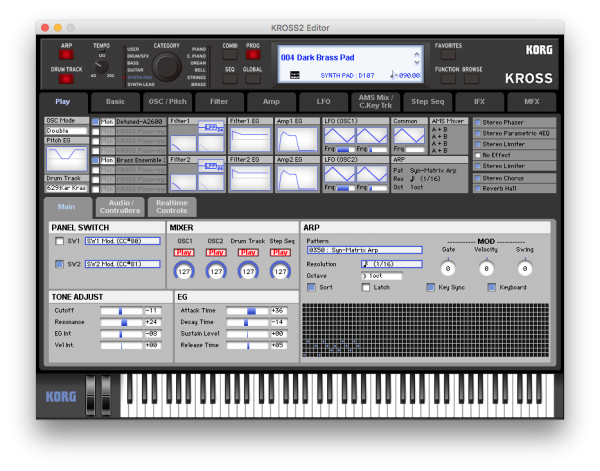
USB Audio/MIDI Interface: 2-in/2-out @ 44.1 kHz/24-bit, class-compliant drivers for macOS, Windows, iOS. Enables direct recording to DAW and monitoring of DAW playback. Korg Kontrol Editor (standalone/VST/AU) provides visual editing. Korg Module app (iOS) for sound browsing.
SD Card Slot: For expansion PCM libraries, audio file import/export, backup.
Specifications Summary
| Category | Specification |
|———-|—————|
| Keyboard | 61-key Natural Touch, velocity sensitive, no aftertouch (88-key NH weighted also available) |
| Sound Engine | EDS-i (PCM + synthesis processing) |
| Maximum Polyphony | 120 voices (single mode 60) |
| Programs | 1,280 User + 265 Preset (1,545 total) |
| Combinations | 896 User + 384 Preload |
| Drum Kits | 58 User + 42 Preload |
| PCM Memory | ~128 MB preset + ~128 MB expansion built-in |
| Sampling | 16 pads, 14 sec/pad, 4 simultaneous, resampling, SD card |
| Effects | 134 types, 5 IFX + 2 MFX + Master EQ |
| Sequencer | 16-track MIDI, 480 ppq, Drum Track, Arpeggiator |
| Audio Interface | USB: 2-in/2-out @ 44.1 kHz/24-bit |
| Display | 320 x 240 color LCD |
| Dimensions 61-key | 935 x 269 x 88 mm (36.81 x 10.59 x 3.46 in) |
| Weight 61-key | 3.8 kg (8.38 lbs) excluding batteries |
| Power | DC 9V (AC adapter) or 6× AA (6h alkaline, 7h NiMH) |
| Consumption | 5 W |
Value and Verdict
The Korg Kross 2 achieves a remarkable synthesis: it packs a full workstation feature set—1,500+ programs, 120-note polyphony, 16-pad sampler, USB audio interface, battery operation—into a 3.8 kg chassis that costs less than many controller keyboards. For the mobile producer, traveling composer, or performing keyboardist who needs a complete production environment that disappears in a backpack, the Kross 2 has no direct competitor.
The compromises are deliberate: basic synth action unsuitable for piano; small LCD requires menu diving for deep editing; 120-note polyphony shared across all engines; plastic build lacks premium feel; no aftertouch; limited expansion memory vs. flagship workstations. But these are the enabling compromises that make the 3.8 kg weight and sub- price possible.
Pros:
– 3.8 kg weight (61-key) is the lightest in class
– 6-hour battery life enables true cable-free creation
– 16 velocity-sensitive pads with 14-sec sampling + resampling
– 1,500+ programs cover every genre
– 120-note polyphony handles dense layering
– USB audio/MIDI interface (2-in/2-out)
– LINE IN for direct sampling
– SD card expansion for PCM libraries
– Korg Kontrol Editor for visual editing
Cons:
– Synth action unsuitable for piano playing
– 3.8 kg plastic build feels lightweight (not premium)
– Small 320×240 LCD requires menu diving
– No aftertouch (channel or polyphonic)
– 120-note polyphony shared across all engines
– Expansion memory ~128 MB may limit large libraries
– No XLR outputs, no balanced outputs
– 88-key NH model is 12.3 kg (loses ultra-portable advantage)
Bottom Line: The Korg Kross 2 is the ultimate mobile workstation—a complete production environment that weighs less than a lunchbox and costs less than a weekend gig pays. For the creator who values mobility and feature density over premium keybed and build, it’s the undisputed category leader.