Introduction
The Yamaha P-125 has been the benchmark for entry-level portable digital pianos since its 2018 debut, inheriting core technologies from Yamaha’s premium Clavinova line while maintaining a sub-12 kg weight and accessible price point. With the Pure CF Sound Engine, Graded Hammer Standard (GHS) keyboard, 192-note polyphony, and Bluetooth MIDI/audio, the P-125 targets beginners, students, gigging pianists needing a lightweight backup, and apartment dwellers seeking authentic piano experience in a compact package.
This review examines whether the P-125 remains the category leader in an increasingly competitive entry-level market.
Design and Build Quality
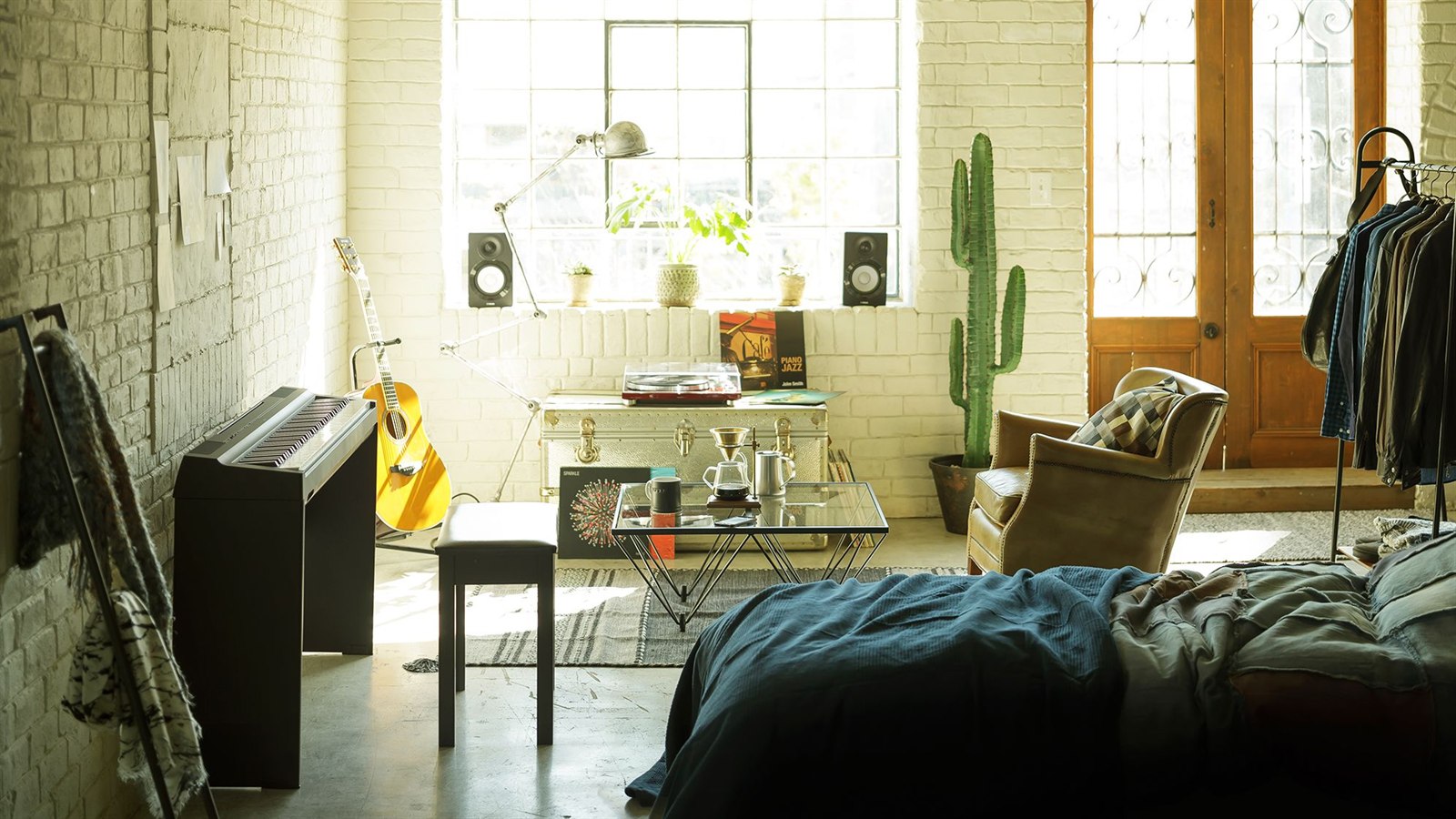
The P-125 presents a clean, minimalist aesthetic: matte-black or white finish, low-profile control surface (volume knob, three function buttons, power), and a sturdy metal music rest. At 1,326 mm wide, 295 mm deep, 166 mm high, and 11.8 kg, it’s one of the most compact 88-key digital pianos available—easily fitting on a desk, small stand, or even a sturdy table.
Build quality exceeds price expectations: rigid chassis with no flex, secure keybed mounting, and a recessed control panel that protects buttons during transport. The included DP-10 damper pedal supports half-pedal detection. Optional KPD-70 three-pedal unit (damper, sostenuto, soft) connects via dedicated port for console-style pedal layout.
The 2 x 12 cm woofer + 2 x 5 cm tweeter speaker system driven by 6 W + 6 W amplifiers is modest but clear. For apartment practice and small rooms, it’s adequate; for ensemble playing, external amplification or headphones are necessary. The Headphones 3D Ambience effect enhances headphone monitoring with spatial processing.
Connectivity covers essentials: 1/4-inch L/Mono and R outputs, headphone jack (single), pedal jack (damper, half-pedal), USB Type-B (MIDI only, no audio), Bluetooth MIDI/Audio (v4.2). The absence of balanced XLR outputs and USB audio is expected at this price.
Keybed and Action: GHS (Graded Hammer Standard)
The P-125 features Yamaha’s GHS (Graded Hammer Standard) keyboard with 88 keys, graded weighting, escapement simulation, and ivory-feel texture on the white keys. This is the same action family found in the FP-30X, FP-60X, and entry-level HP/RP console pianos—a proven design that has set the entry-level benchmark for years.
The action uses a hammer mechanism with shorter pivots and lighter counterweights than the premium GH3/NWX actions, resulting in a lighter overall touch (approx. 45–55 g at middle C vs. 50–60 g on GH3). The escapement click is present but subtler. The ivory-feel surface absorbs moisture, preventing slippage during extended sessions.
For a beginner or intermediate player, the GHS action delivers an authentic piano response: graded weighting across the compass, velocity sensitivity that translates dynamic intention accurately, and a mechanical feel that encourages proper technique development. It’s significantly better than the spring-action or semi-weighted keyboards found on many competitor entry-level models.
The action’s lighter touch may feel insufficient for advanced classical pianists accustomed to concert grand resistance, but for the target audience—beginners, hobbyists, students—it’s an ideal balance of realism and playability. Four touch sensitivity curves (Light, Medium, Heavy, Fixed) accommodate developing technique.
Sound Engine: Pure CF Sound Engine
The P-125 uses Pure CF Sound Engine—Yamaha’s sample-based piano technology with modeling enhancements. The engine combines multi-sampled piano waveforms (stereo, multiple velocity layers, key-off samples) with real-time modeling of:
– String resonance (sympathetic vibration of undamped strings)
– Damper resonance (harmonic bloom when damper pedal is depressed)
– Key-off response (mechanical return sound)
– Cabinet resonance (body coloration)
The result is a piano sound that responds organically to touch and pedal, far beyond static sample replay. The P-125 includes 4 piano tones (Concert, Ballad, Bright, Mellow) plus 2 electric pianos, 2 organs, and 9 other tones (strings, pad, bass, etc.)—24 tones total.
The Piano Designer parameters (via Smart Pianist app) allow adjustment of lid position, string resonance, damper resonance, key-off noise, and single-note voicing—providing meaningful customization despite the entry-level positioning.
Polyphony and Performance
192-note polyphony is a significant advantage over competitors at this price (typically 64–128). For solo piano practice, 192 notes is effectively unlimited. Even with heavy damper pedal, dense chords, and layering (piano + strings), voice stealing is virtually impossible. The non-piano tones share the same polyphony pool.
Bluetooth MIDI + Audio (v4.2) enables wireless connection to Smart Pianist (free app) for deep editing, recording, and lessons, plus audio streaming from mobile devices for play-along.
USB Type-B provides MIDI-only connectivity for computer integration. Smart Pianist provides: Piano Designer parameter access, MIDI recorder/player (SMF), sheet music viewer (MusicXML), lesson functions (built-in songs, tempo control, part mute), rhythm accompaniment (20 styles), and metronome.
The single pedal jack supports the included DP-10 damper pedal with half-pedal detection.
Specifications Summary
| Category | Specification |
|———-|—————|
| Keyboard | 88-key GHS, graded hammer, escapement, ivory feel |
| Sound Engine | Pure CF Sound Engine (sample + modeling) |
| Maximum Polyphony | 192 notes |
| Piano Tones | 4 (Concert, Ballad, Bright, Mellow) |
| Other Tones | 2 E.Piano, 2 Organ, 9 Others (24 total) |
| Speaker System | 12 cm x2 + 5 cm x2, 6W + 6W |
| Effects | Reverb (4), Brilliance (10), IAC, Damper Resonance, Sound Boost |
| Functions | Dual/Layers, Split, Duo, Metronome (5-280), Transpose (±6), Tuning, Rhythm (20), Recorder |
| Connectivity | USB TO HOST (MIDI), Phones/Output, Pedal, AUX IN, Bluetooth MIDI+Audio |
| Dimensions (W x D x H) | 1,326 x 295 x 166 mm (52.20 x 11.61 x 6.54 in) |
| Weight | 11.8 kg (26.01 lbs) |
| Power | 6 W (PA-150B adapter) |
| Colors | Black, White |
Value and Verdict
The Yamaha P-125 remains the entry-level portable piano benchmark for a reason: it preserves the essential musical DNA—graded hammer action, modeling-enhanced piano sound, wireless connectivity—while stripping only the non-essentials. For a beginner, student, returning player, or gigging pianist needing a lightweight backup, the P-125 provides everything needed to develop proper technique and musicality.
The compromises are transparent: 6 W speakers are for personal monitoring only; USB lacks audio; single pedal jack; plastic chassis; 24 tones total (limited non-piano palette); no LCD display (app-dependent). But these are the right compromises to hit the price point while preserving the musical core.
Pros:
– GHS graded hammer action with escapement and ivory feel
– Pure CF Sound Engine with string/damper resonance modeling
– 192-note polyphony (class-leading at this price)
– Bluetooth MIDI + Audio (rare at this price)
– Smart Pianist app provides deep editing, lessons, recording
– 11.8 kg weight is exceptionally portable
– Half-pedal support on included damper pedal
– Duo mode splits keyboard for teacher/student
Cons:
– 12 W speaker system is for personal practice only
– USB MIDI only (no audio interface)
– Single pedal jack (no assignable pedal)
– Plastic chassis feels utilitarian
– Only 24 tones total (limited non-piano palette)
– No LCD display (app-dependent editing)
– No balanced outputs
– No Bluetooth MIDI on some regional variants (check specs)
Bottom Line: The Yamaha P-125 remains the best entry-level portable digital piano for developing pianists. It preserves the essential musical DNA—hammer action, modeling piano sound, wireless connectivity—while stripping only the non-essentials. For the price, nothing else comes close to this level of musical authenticity.